Your rating
Reactions
AudioEnglish (original)Auto-dubbed: French, German, Spanish, Arabic, Hindi, Indonesian, Italian, Portuguese
Description
Promos
Check out this ACTUAL Hologram: bit.ly ~ Chapters: 00:00 Hologram* 00:17 WTF EVEN IS A HOLOGRAM???? 01:45 How to Make a REAL Hologram 03:49 The Real Tech Innovation 05:02 How to Make a Volumetric Display 06:24 Meet the Voxon VX2 09:22 But... what does it do? Shop the merch: shop.mkbhd.com Join the Discord: discord.gg Music licensed from Epidemic Sound: share.epidemicsound.com Follow The Studio: twitter.com @thestudio Follow the staff: Marques Brownlee twitter.com Olivia Bransford @livbransford Adam Molina @parmesanpapi17 Alex Wolfe bsky.app Andrew Manganelli @andrew_manganelli Brandon Havard @havard.jpg David Imel @DurvidImel Ellis Rovin @ellisrovin Eric Villa @eric.p.v Harper Makowsky @harper_mak Jono Tan @burntbanana Mariah Zenk @totallynotabusinessacc Michael Emerick @emerickm Miles Somerville @carswithmiles Rich Ho @richontrack Rufus Mullhaput @rmullhaupt Tim McMahon @timmcmahonn Vinh Dang @danggvinh Equipment used in this video and others: Canon EOS C70: geni.us Canon RF 15-35mm f/2.8L: howl.me Canon RF 28-70mm f/2.8L: geni.us Sennheiser MKH-416: geni.us Sennheiser ME 2 lav: geni.us PowerDeWise lav: geni.us Zoom F8n Pro: geni.us Hollyland Lark Max: geni.us Shot & Edited by Rich Ho & Eric Villa Technical Producer & Colorist - Rich Ho Content Strategist & Line Producer - Eric Villa Audio by Ellis Rovin Graphics by Tim McMahon and Michael Emerick
AI Overview
The video distinguishes real holography from familiar displays often called holograms, such as rear projection on transparent screens and Pepper’s Ghost effects. Those examples show flat images rather than objects with depth. A traditional hologram records three-dimensional light information as an interference pattern, created by splitting a laser into beams that travel different paths. When the pattern is reproduced on a surface and illuminated, it can recreate light that appears to come from different depths, giving viewers parallax as they move. This makes a real hologram more like a flat window into a scene than a floating image. The video points to 3Blue1Brown for a deeper physics explanation.
Topics · science & technology · holography · display technology
Questions answered
- What is a hologram technically?
- A hologram is a technique for recording three-dimensional light information as an interference pattern, which can reproduce depth and parallax when illuminated.
- How are traditional holograms made?
- A laser is split into two beams. One reflects off the object and the other reaches the recording medium directly; where the beams meet, their interference pattern records information about the object.
- How does the Voxon VX2 create a volumetric image?
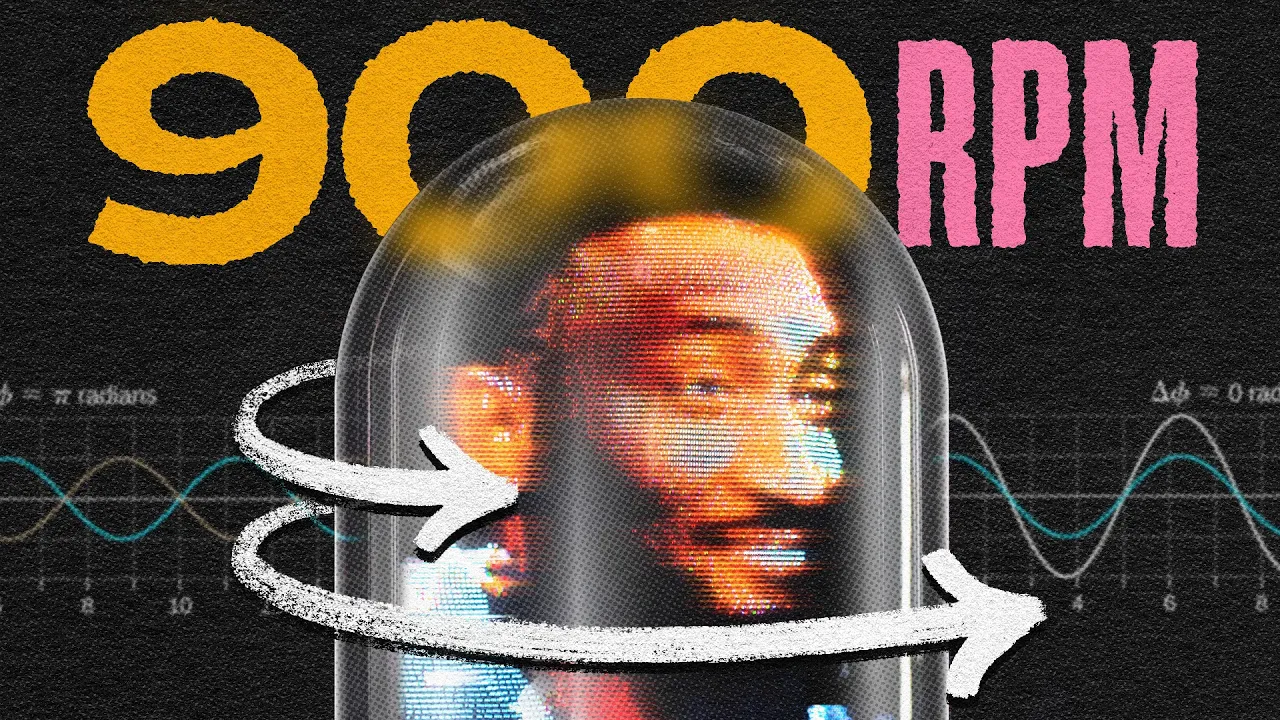
- The VX2 spins LED panels and displays vertical slices of a 3D object at precise points in each rotation. Persistence of vision makes the rapidly shown slices appear as a three-dimensional image.
- Why is the Voxon VX2 difficult to build?
- It spins at 900 RPM and must coordinate about 480 slices per rotation. At 30 frames per second, the panels need roughly 7,200 updates per second, while the system also manages timing errors, wireless power and data transfer, and panel flex.
- What is the Voxon VX2 designed to offer viewers?
- It is presented as an experimental display for shared, 360-degree viewing, where people can stand around the content and see one another. It is not the studio’s highest-resolution or most color-accurate display, and it can flicker in person.