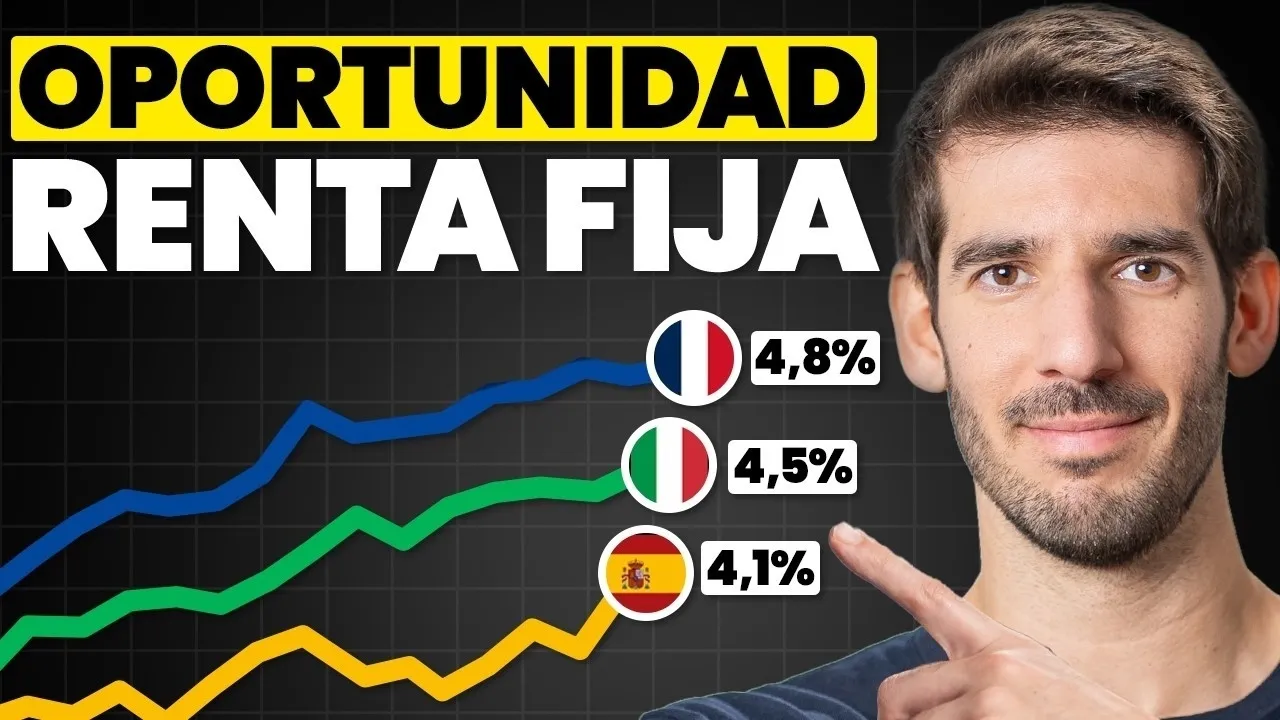
Cómo aprovechar los Nuevos tipos de Interés para Ganar Dinero (sin riesgo)
This video also has English audio (auto-dubbed). In the player, open Settings → Audio track and choose English.
Your rating
Reactions
AudioSpanish (original)Auto-dubbed: English, Arabic, Portuguese
Description
La inversión en Renta Fija ofrece rentabilidades que no se veían desde hace décadas. En este analizamos cómo podemos aprovechar estos tipos altos a nuestro favor invirtiendo en renta fija de forma sencilla y minimizando el riesgo.
TALLER DE INVERSIÓN
══════ Taller Gratis de Inversión + Agente de IA de regalo por apuntarte
Promos
Aquí puedes abrir tu cuenta Gratis para invertir con MyInvestor: myinvestor.es (20€ de regalo al registrarte con el código: INVERTIRPC) Publi. El contenido de este Canal tiene fines únicamente educativos y en ningún caso suponen recomendaciones de inversión o asesoramiento financiero. Rentabilidades pasadas no garantizan rentabilidades futuras. Invertir en fondos conlleva riesgos. Puedes perder parte o todo tu dinero. La información y riesgos de cada fondo figura en los Datos Fundamentales para el Inversor (DFI) disponibles en la web de MyInvestor y en la CNMV (cnmv.es). ══════
Criptan - La plataforma cripto que utilizo para invertir en Bitcoin de forma automatizada y generar intereses. ➜ criptan.com (Consigue un 35% extra de rentabilidad en tu 1er depósito con el código: invertirconseguir) ══════ SÍGUEME EN MIS REDES SOCIALES ═════ ➤ Instagram: @invertirparaconseguir ➤ TikTok: @invertirparaconseguir ➤ Twitter: twitter.com ══════════════ Marcas de tiempo 00: ══════════════ Carlos Barrera Pasán Asesor financiero certificado por EFPA, EIP (nº 20240325) ══════════════ DESCARGO DE RESPONSABILIDAD: Invertir conlleva riesgos. Todo inversor debe realizar un análisis previo antes de tomar una decisión de inversión y ser responsable de sus acciones. El contenido de este canal tiene fines únicamente educativos y en ningún caso supone una recomendación de inversión o asesoramiento financiero. Algunos de los enlaces compartidos son links promocionales. Si decides utilizarlos, yo también me llevaré una recompensa sin que suponga ningún coste adicional para ti. ¡Muchas gracias por apoyar el canal!
AI Overview
The video explains why higher interest rates have made fixed income more attractive, while emphasizing that bonds are not risk-free. It cites yields discussed for the U.S. market, including about 3.5% for money-market fixed income, 5% for 10-year Treasuries, and around 5.7% for investment-grade credit. It also compares European government bond yields, noting that Spain’s 10-year bonds were around 4% and its 12-month bills offered more than 3%. The presenter contrasts these yields with stock market volatility and explains that the S&P 500’s earnings yield was presented as about 3.8%, below the 5.2% yield on 10-year Treasuries. The video argues that bonds may improve a portfolio’s risk-adjusted return, but says that combining bonds and stocks can be sensible. Its figures and forecasts are presented as current-market data, not guarantees of future returns.
Topics · education · personal finance · investing · fixed income · bonds
Questions answered
- What yields does the video cite for fixed-income investments?
- It cites about 3.5% for U.S. money-market fixed income, 5% for 10-year U.S. Treasuries, and around 5.7% for U.S. investment-grade credit. For Europe, it gives Spain’s 10-year government bond yield as around 4% and its 12-month bill yield as above 3%.
- Why consider bonds alongside stocks when interest rates are high?
- The video argues that bonds can offer attractive income with less risk than stocks and may cushion portfolio losses. It notes that bonds ended positively in 21 of 25 years when the U.S. stock market was negative in the period discussed.
- What rules does the video suggest for reducing risk when investing in bonds?
- It suggests choosing short-term bonds or funds with short duration, favoring creditworthy government and corporate issuers, and investing in euros or using currency-hedged investments to limit exchange-rate risk.
- Which two bond funds are presented as examples, and what are their stated yields?
- The examples are Vanguard Global Short-Term Corporate Bond, with a stated 4.6% yield to maturity, 0.18% annual fee, and 2.7-year duration, and B&H Bonds LU, with a stated 6.2% expected return, 0.72% annual fee plus a 3% performance fee, and 2.55-year duration.
- Who might benefit from a short-duration bond strategy, and who might prefer stocks?
- The strategy may suit people who need money in two or three years, want stability or income, seek less stock-market exposure, or want to reduce portfolio risk. The presenter says it may be less suitable for long-term investors who can tolerate volatility, since stocks may offer higher returns over long periods.


