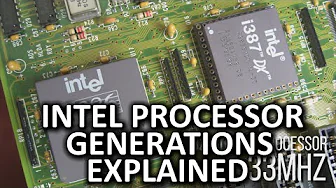
Intel Processor Generations As Fast As Possible *CORRECTED*
Your rating
Reactions
AudioEnglish (original)Auto-dubbed: French, Italian, Portuguese
Promos
Intel CPUs have changed a lot since they released their first processor all the way back in 1971... lynda.com message: Sign up for your 10-day FREE trial at lynda.com Follow: twitter.com Join the community: linustechtips.com Licenses for images used in this video: creativecommons.org gnu.org Pentium, Intel Core, Celeron, Centrino, Intel Inside, and the Intel logo and sonic logo are trademarks of Intel Corporation.
AI Overview
The video traces the evolution of Intel processors from the early 1970s to the modern era, framing the journey around Moore's Law and the ongoing pursuit of better performance. It opens by revisiting Intel's first microprocessor, the 404, and then moves forward to the 8086 era, which established the x86 instruction set that still underpins modern CPUs. The presenter highlights critical milestones such as the 386 introducing 32-bit architecture, the Pentium generations bringing MMX and on-die cache innovations, and the move to on-board memory controllers with mainstream socket changes that shifted latency dynamics. A substantial portion covers the transition into multi-core designs with the Core 2 family, marking the end of the GHz race as efficiency gains began to outpace raw clock speed. The narrative continues through the era of Core i3, i5, and i7, noting the ongoing improvements in I/O, power efficiency, and integrated graphics, while observing that yearly gains often hover around the 10 to 15 percent range. Overall, the video presents a compact timeline that connects architectural shifts, socket evolution, and the strategic balance between speed, efficiency, and multicore capabilities, culminating in a view of how Intel stabilized its leadership while AMD pressed for competitive breakthroughs.
Topics · science and technology · computing history · hardware hardware-design
Questions answered
- What was the significance of the 386 DX in CPU history?
- The 386 DX was Intel’s first 32-bit x86 processor, increasing addressable memory to 4 GB and enabling more capable computing beyond 16-bit systems.
- Why is Core 2 considered a turning point for Intel’s desktop lineup?
- Core 2 introduced a strong balance of performance and efficiency, ending the GHz race and establishing a new baseline for multi-core desktop performance.


