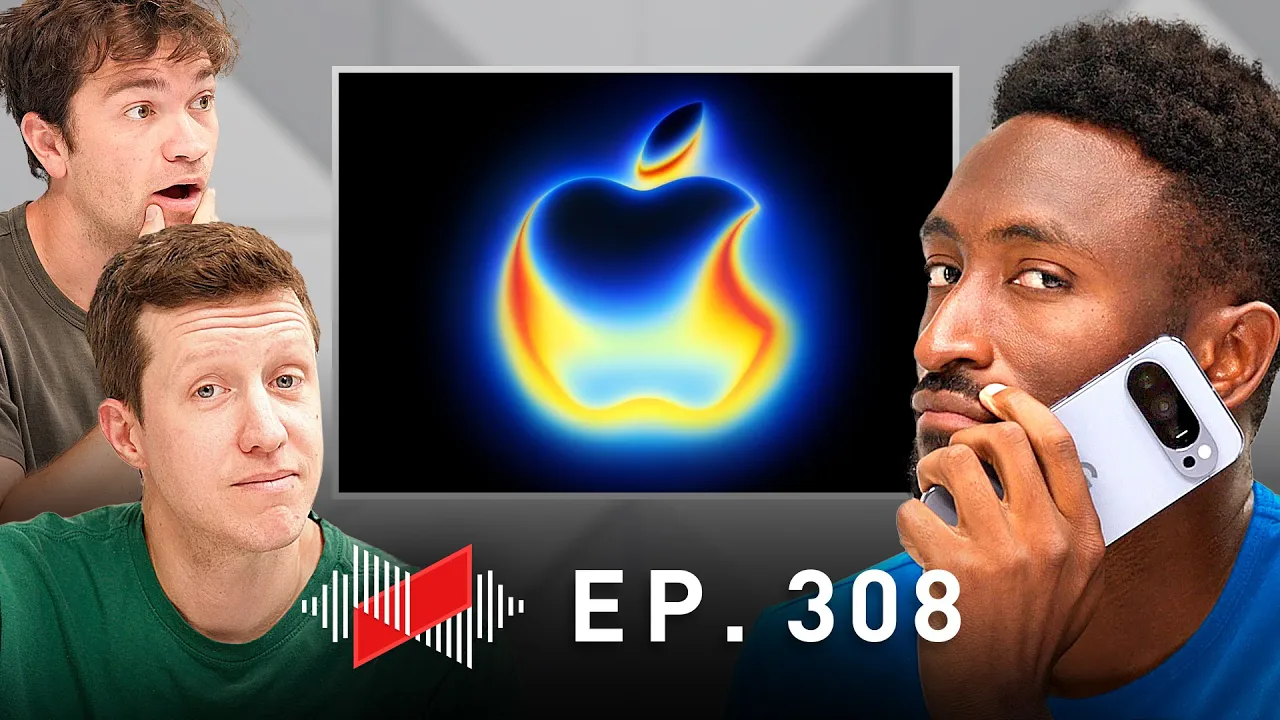
What Does the iPhone Event Invitation Mean?
Your rating
Reactions
Promos
This week, Marques, Andrew, and David talk about everything from the new Hasselblad camera to the upcoming Apple event! First, they talk cameras for a bit before going over some final thoughts of the Pixel 10 phones. Then they try to figure out what the Apple event invite could be telling us before finally talking about Hollow Knight Silksong for a bit. It's a fun one! Chapters 00:00 Intro 01:17 French dub? 03:37 Hasselblad X2D 22:22 Nothing Phone 3 stock photos 34:59 Framer (Sponsored) 36:26 Pixel 10 thoughts 57:56 Apple event announced 01:07:16 Apple might be using Gemini 01:17:40 Ad break 01:17:44 Hollow Knight Silksong 01:23:09 YouTube Hype has launched 01:26:56 Trivia answers 01:31:32 Outro Links: Pixel 10 Review: youtube.com Verge - Hasselblad X2D II: youtu.be B&H - Ricoh GR Iv: youtu.be Team Cherry - Hollow Knight silk song trailer: youtube.com Music provided by Epidemic Sound Shop the merch: shop.mkbhd.com Social: Waveform Threads: @waveformpodcast Waveform Instagram: @waveformpodcast Hosts: Marques: @mkbhd Andrew: @andrew_manganelli David: @davidimel Adam: @parmesanpapi17 Ellis: twitter.com TikTok: @waveformpodcast Join the Discord: discord.gg Music by 20syl: bit.ly Waveform is part of the Vox Media Podcast Network.
AI Overview
The hosts open with a joke about a badly produced French dub of an older video, explaining that it was a human dub from a past test that has since been taken down. They then discuss the Hasselblad X2D, which Marques praises for its medium-format 100-megapixel sensor, improved autofocus, true HDR, and unusually strong in-body stabilization. The camera is still an expensive, specialized purchase, but its lower price than the previous model and some competing medium-format cameras surprises the hosts. They also joke about Marques being tempted to buy it despite repeatedly insisting he does not need it. The camera conversation shifts to the Ricoh GR IV, a compact fixed-lens camera aimed at people who want something genuinely pocketable. The hosts say its new features include a 26-megapixel APS-C sensor, a redesigned lens, improved autofocus, built-in storage, and stronger image stabilization, while noting that the price has risen to $1,500. They compare its appeal with the Fujifilm X100 series and inexpensive older digital cameras, observing that social-media popularity and limited supply can drive prices up. They also cannot verify what “GR” stands for, and laugh about an invented explanation circulating online. Next, the hosts discuss reports that Nothing Phone 3 demo displays showed stock photos as examples of pictures taken by the phone. Nothing’s co-founder reportedly described them as placeholder images that were not replaced before launch, but the hosts question why professionally licensed photos were used in the first place. The story leads to a broader discussion of smartphone camera marketing and whether image quality still meaningfully separates flagship phones for most buyers. They argue that professional equipment is often valuable for job-specific features and workflow, not simply because it produces a better-looking image. The hosts criticize claims that phone photos demonstrate professional-grade results, pointing out that professional photographers also benefit from carefully chosen lighting and staging. They contrast polished promotional images with ordinary photos people take of family and pets, and discuss how phone image processing can create a recognizable look. The discussion briefly turns to Sam Altman’s comments about whether smartphone photos count as pictures, which the hosts consider a misleading comparison with generated or invented imagery. A trivia question about Hasselblad follows, before the show pauses for an advertisement. After the Framer ad, the hosts compare their early experiences with the Pixel 10 phones. One host describes an aging iPhone with screen problems and says he is temporarily using a OnePlus Open, while another praises the Pixel 10 Pro’s built-in magnetic accessory support. The hosts say Google is building an ecosystem that increasingly resembles Apple’s, including Pixel Care Plus, but note that switching from iPhone can still be difficult. They also discuss battery life, display smoothness, and the limits of the Pixel’s Tensor processor. The Pixel discussion continues with Magic Q, a messaging feature that attempts to surface personal information such as flight details from messages or calendars. The hosts report inconsistent results, including outdated or incorrect trip information, and warn that a suggested answer could be sent without being edited. They see conversational photo editing as a stronger feature, describing how a user can request changes such as removing a car or making the sky bluer. Their overall view is that the Pixel remains recognizably a Pixel, with useful software and AI features but no major hardware transformation. The hosts say Google is trying to make Pixel phones easier for mainstream buyers to consider, including people who already use iPhones. They praise the broad accessory compatibility but say the Tensor G5’s graphics performance is not a major leap. Their camera discussion finds that normal wide-angle photos look good, while zoom results can look soft and lose detail, especially compared with some competing phones. They also compare the base Pixel 10 and Pro models, noting that the smaller gap between them can make the base model seem like better value, while storage pricing remains a complaint. The conversation turns to Apple after the company announces its iPhone 17 event for September 9. The hosts inspect the invitation’s colorful, liquid-glass-like design and describe its animated colors as resembling a heat map or thermal image. They debate whether the visual hints at a thermal camera, new colors, or another feature, but do not reach a firm conclusion. They also discuss Apple’s “Awe dropping” tagline and speculate that the thin iPhone 17 Air may be the invitation’s main design reference. The hosts connect the rumored iPhone 17 Air to Apple’s possible work on thinner components and a future foldable phone, while emphasizing that this is speculation. They discuss rumors of blue and orange Pro colors and a vapor chamber cooling system, joking that Apple could frame the hardware as necessary for running Liquid Glass. The cooling idea has a practical angle for the hosts, who say iPhones can dim their displays or overheat during extended video recording, especially when connected to USB-C accessories. They consider better sustained performance and recording reliability more meaningful than purely cosmetic explanations. Before a break, the hosts discuss a report that Apple may work with Google Gemini to support a revamped Siri. They note that Apple announced a more capable Siri earlier but has not yet delivered it, and that recent reports of shifting teams and possible partnerships suggest the work is still underway. The hosts question how a Google model would fit with Apple’s privacy messaging and wonder whether it might run locally or be used for more complex requests. They also recall that Apple had previously discussed offering users a choice of external AI services. The AI discussion broadens to Apple’s machine-learning research and its published critiques of language and reasoning models. The hosts say the research reflects limitations in current AI systems, while also noting that Apple may have different standards for releasing a finished product. They contrast Apple’s established iPhone business with companies whose market valuations are more tied to expectations about future AI dominance. The segment ends with the observation that investors are making long-range bets on uncertain technology, followed by a transition to trivia about old YouTube features. The hosts talk about YouTube annotations, recalling both creative uses such as interactive videos and abuse such as links to malicious websites. They argue that a simple text annotation system could help creators correct mistakes in published videos, though they acknowledge that platform features can be misused. The discussion includes a humorous reference to Mystery Guitar Man and then moves into the next break. The main point is that video corrections are harder to make transparently than corrections on a webpage. After the break, the hosts discuss Hollow Knight: Silksong and its long development. They explain that it began as a planned expansion to Hollow Knight before growing into a separate game, and that the developers delayed it while adding more content. The announced release date is September 4, and the hosts note that some indie developers have delayed their own games to avoid competing with its launch. They compare the situation with technology companies moving event dates and say the decision can be especially important for small game teams. The game discussion ends with jokes about other long-awaited releases and albums, then the hosts introduce YouTube Hype. They describe it as a way for viewers to give extra visibility to videos from channels with between 500 and 500,000 subscribers. Hype points are weighted to favor smaller channels, and videos must be less than seven days old to qualify. The hosts explain where to find the feature in the mobile app, while questioning the option to pay for additional hype and suggesting direct creator support as an alternative. The final segment returns to trivia, revealing that a Hasselblad camera took a photograph of Earth from the Moon and giving January 2019 as the year YouTube removed annotations from existing videos. The hosts compare their quiz answers and tally the episode’s points, with Andrew finishing in first place. They close by crediting the producers, identifying Waveform as part of the Vox Media Podcast Network, and signing off.
Topics · apple · iphone · android · google · podcast · technology · photography · gaming
Questions answered
- What does the iPhone event invitation suggest about the iPhone 17?
- The invitation’s animated, heat-map-like colors prompted speculation about new colors, cooling, or other features, but the hosts did not identify a definite meaning. They thought the “Awe dropping” tagline could refer to the iPhone 17 Air’s rumored thin design.
- When is Apple’s iPhone 17 launch event?
- Apple announced the event for September 9.
- Why did Nothing Phone 3 demo displays show stock photography?
- Nothing’s co-founder reportedly said the photos were placeholders submitted months before launch and were not replaced.
- What were the hosts’ main complaints about Pixel 10 zoom photos?
- They found zoom photos soft and lacking in fine detail, particularly at higher magnifications, although they said ordinary wide-angle photos looked good.
- What is YouTube Hype designed to do?
- It lets viewers give eligible videos from channels with 500 to 500,000 subscribers points intended to help those videos gain visibility.
- Why have some indie game developers delayed releases around Hollow Knight: Silksong?
- They want to avoid competing for attention with a highly anticipated game, and some developers say delaying gives their smaller teams a better chance.