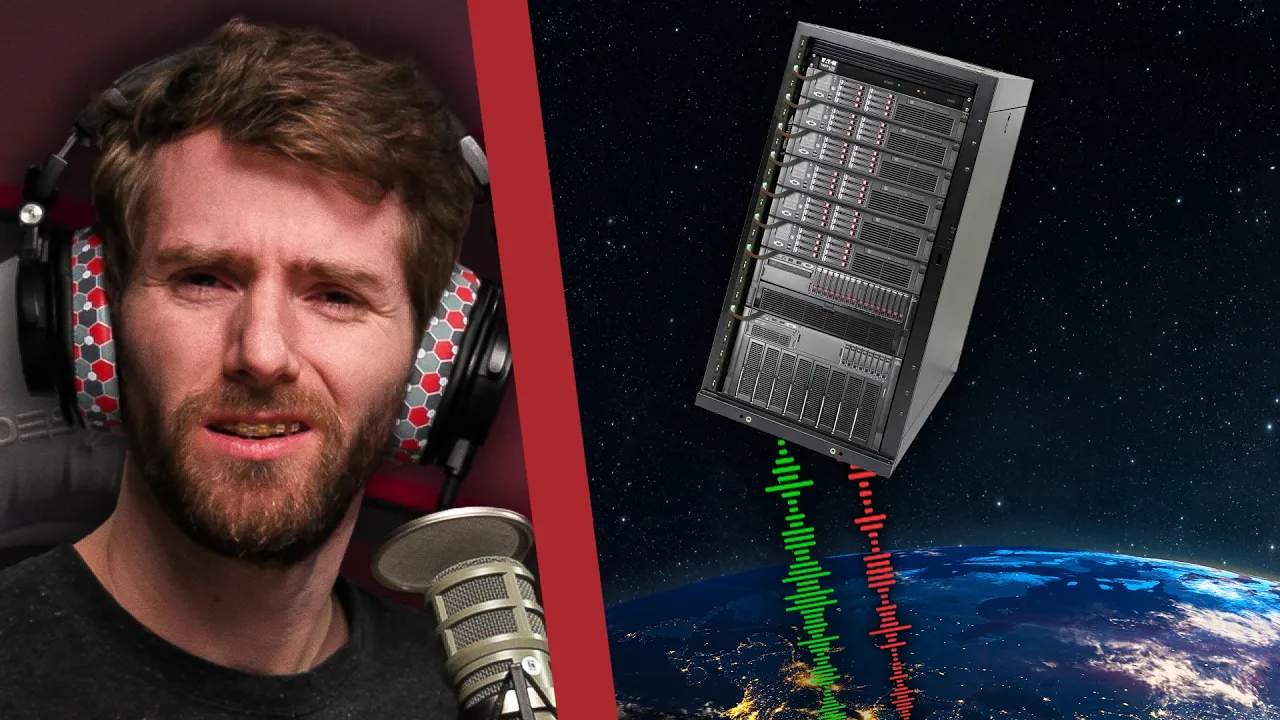
Data Centers in Space Are a Complicated Mess
Your rating
Reactions
AudioEnglish (original)Auto-dubbed: Dutch, French, German, Spanish, Arabic, Bangla, Hebrew, Hindi, Indonesian, Italian+6 more
Description
Thanks to our WAN clips sponsors dbrand and Razer. You can check them out at the links below: dbrand: dbrand.com
Channels and socials
Check out the Razer Blade series of laptops; perfect for work or pleasure: lmg.gg Game or work in comfort on a Razer Iskur V2: lmg.gg Intel filed a patent for a space based data center concept using a few powerful satellites to manage thousands of simpler ones. Linus and Luke discuss why cooling, power, and space junk make orbit the worst possible location when the Arctic and the mountains are still sitting empty. Watch the full WAN Show: youtube.com ► SHOP OUR PRODUCTS: lttstore.com ► GET EXCLUSIVE CONTENT ON FLOATPLANE: lmg.gg ► SPONSORS, AFFILIATES, AND PARTNERS: lmg.gg
AI Overview
Intel’s patent describes a possible space-based data center network in which a small number of higher-orbit satellites handle routing, coordination, and other demanding computing for many simpler satellites. The hosts stress that the filing continues an application dating to 2022, so it is not evidence that Intel is building the system. They joke about increasingly grand proposals such as asteroid or lunar data centers before focusing on the risks of adding thousands of satellites to orbit. More objects could contribute to collisions and cascading debris, a concern discussed through Kessler syndrome and the growing visibility of satellites in the night sky. The discussion questions whether launching and operating data centers in orbit makes economic or practical sense compared with building them on Earth. The hosts argue that cold terrestrial regions, including the Arctic and northern areas, could offer alternatives that do not require launching large amounts of hardware. They say latency is not necessarily the main obstacle, pointing to Starlink as an example of satellite connectivity that can work effectively. Instead, they emphasize cooling: without an atmosphere to transfer heat, orbital hardware would need substantial radiator arrays, while high-power processors would create a difficult thermal load. The hosts compare an estimated 2,000-watt AMD Instinct processor with the International Space Station’s reported heat-dissipation capacity, using the comparison to illustrate how large the cooling systems might need to be. They also note that a space data center would need large power arrays in addition to cooling equipment, and that processor power demands are not clearly trending downward. The point is not that orbital computing is impossible, but that the same resources could likely support terrestrial data centers in remote areas. They describe the proposal as an engineering challenge without an obvious need, given that many suitable places on Earth remain available. The conversation then distinguishes a large orbital data center from smaller, distributed computing or storage on satellites. The hosts say satellite-based storage or limited computing could be useful for serving remote customers, caching frequently requested data, or supporting future satellite-connected devices. They discuss how existing space communications can involve significant delays, including a reported six-second delay during communication between the ISS and Orion, which they attribute partly to legacy infrastructure and processing. Their conclusion is that more computing in space could make sense in specific forms, but simply moving a conventional, power-hungry data center into orbit appears less practical than using terrestrial sites.
Topics · science & technology · tech · podcast · clip · opinion
Questions answered
- What does Intel’s space data center patent concept propose?
- A few higher-orbit satellites would handle routing, coordination, and other demanding computing for thousands of simpler satellites. The filing is a patent concept, not confirmation that Intel is building the system.
- Why could space debris make orbital data centers risky?
- More satellites increase the number of objects that could collide and create fast-moving debris. Further collisions could produce more fragments, worsening the space-debris problem associated with Kessler syndrome.
- Why is cooling a major challenge for data centers in space?
- Without an atmosphere to carry heat away, orbital hardware would need large radiator arrays to shed heat. High-power processors could make that cooling equipment especially substantial.
- Is latency the main problem with space-based data centers?
- The hosts argue that latency is not necessarily the main obstacle, and point to Starlink as evidence that satellite connectivity can be effective. They focus more on cooling, power, launch costs, and debris.
- What terrestrial alternatives to orbital data centers are discussed?
- Remote and cold regions, including the Arctic, northern Canada, and mountainous areas, are suggested as places to build data centers without launching the infrastructure into orbit.
- Could satellite-based computing or storage still be useful?
- Yes. The hosts consider limited storage or computing on satellites potentially useful for caching data closer to remote customers and supporting satellite-connected devices.