Unboxing a PETABYTE of Storage - HOLY $H!T Ep. 16
Your rating
Reactions
Description
Check out Ibuypower & MSI’s laptops featuring Intel's 7th Generation Core i7 7700K processor on Amazon: geni.us Buy Seagate Enterprise 10TB drives on Amazon: geni.us Discuss on the forum: linustechtips.com Our Affiliates, Referral Programs, and Sponsors: linustechtips.com
Promos
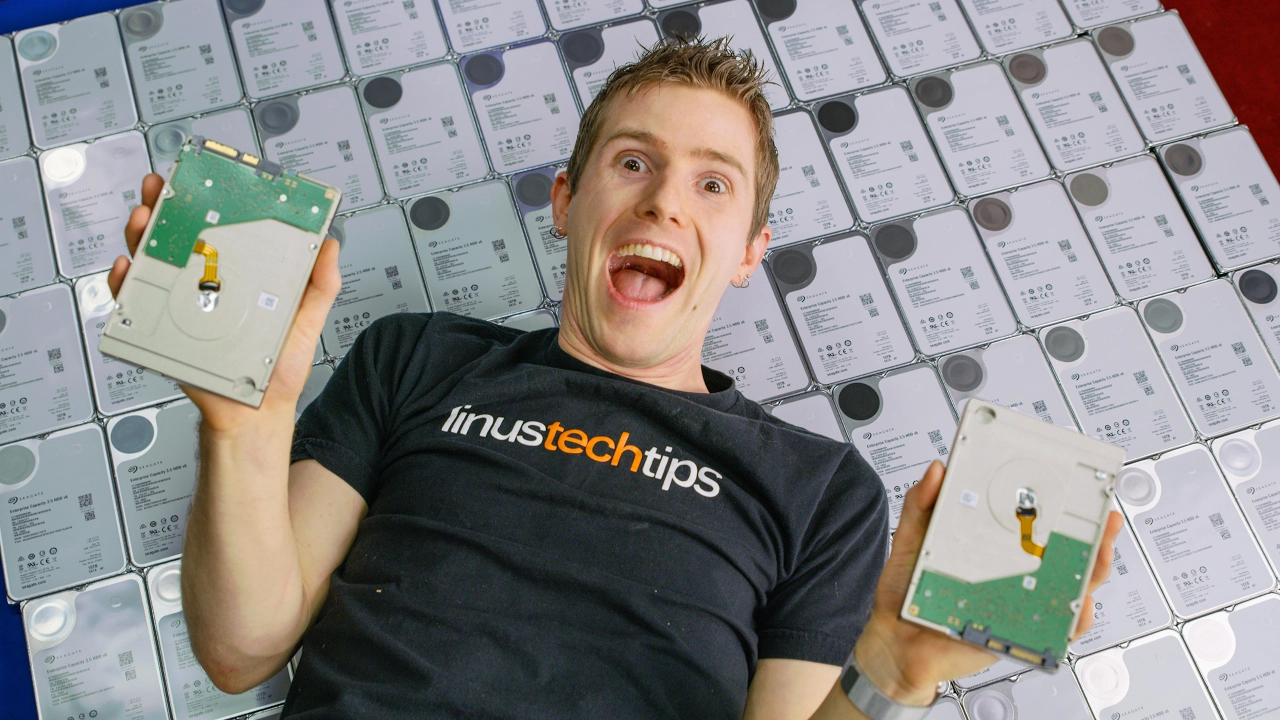
Seagate provided us with a petabyte of their enterprise capacity 10TB drives. Let's see exactly what that much storage looks like... iFixit link: Use offer code LINUS to save $5 off a purchase of $10 or more at ifixit.com
Channels and socials
Check out our Linus Tech Tips posters at crowdmade.com twitter.com @LinusTech Intro Screen Music Credit: Title: Laszlo - Supernova Video Link: youtube.com iTunes Download Link: itunes.apple.com Artist Link: soundcloud.com Outro Screen Music Credit: Approaching Nirvana - Sugar High youtube.com Sound effects provided by freesfx.co.uk
AI Overview
The video provides an in-depth, practical look at assembling and evaluating a petabyte-scale storage setup. It starts with the jaw-dropping concept of a petabyte and immediately clarifies what that quantity means, defining a pedabyte as a thousand terabytes and illustrating the scale with multiple heavy boxes and a large stack of 10 TB Seagate Enterprise helium-filled drives. The presenter walks through the physical delivery process, noting the care and challenge of handling 100 drives, and explains why helium-filled drives are chosen for efficiency and reliability in a long-term archival context. He also introduces the hardware platform he plans to use, the Storinator, highlighting its suitability for housing large drive counts and its simple direct-drive connections to host bus adapters, which minimizes fail points. The discussion then shifts to the software stack and architecture decisions: Unraid is insufficient for this project due to array limits, so the plan is to split drives into VDEVs using a Linux-based system with ZFS and GlusterFS, enabling them to act as a single transparent networked storage pool. GlusterFS is praised for its open-source nature and native SSD tiering support, and Seagate is poised to supply high-speed PCIe Nitro cards to accelerate performance in front of the mechanical drives. The narrative emphasizes that the ultimate capacity is expected to be around 800 terabytes after configuration, and the team candidly contemplates the purpose of archiving such vast data, including the rationale of preserving high-resolution 8K footage and the potential future expansion paths including tape archives for cold storage. The video closes with a light-hearted nod to the trusty ProTek toolkit from iFixit, reinforcing practical, hands-on repair and upgrade readiness, and a call to action encouraging viewers to engage with the channel, purchase merchandise, and explore related content while teasing the next related project or video. The overall tone blends technical depth with a sense of humor about scale, cost, and the evolution of data storage technology.
Topics · technology · hardware · storage · video-production · data-center · archive · open-source · network-storage
Questions answered
- What drives were used for the petabyte storage setup and why?
- Seagate Enterprise Capacity 10 TB helium-filled drives were used for their larger capacity and efficiency in helium-filled enclosures, which suits long-term archival and high-density storage needs.
- Why not use Unraid for this project
- Unraid was unsuitable because it limits to one array per system and 30 drives per array, so the team opted for a two 60-drive model approach using Linux with ZFS and GlusterFS to create a scalable, distributed storage solution.