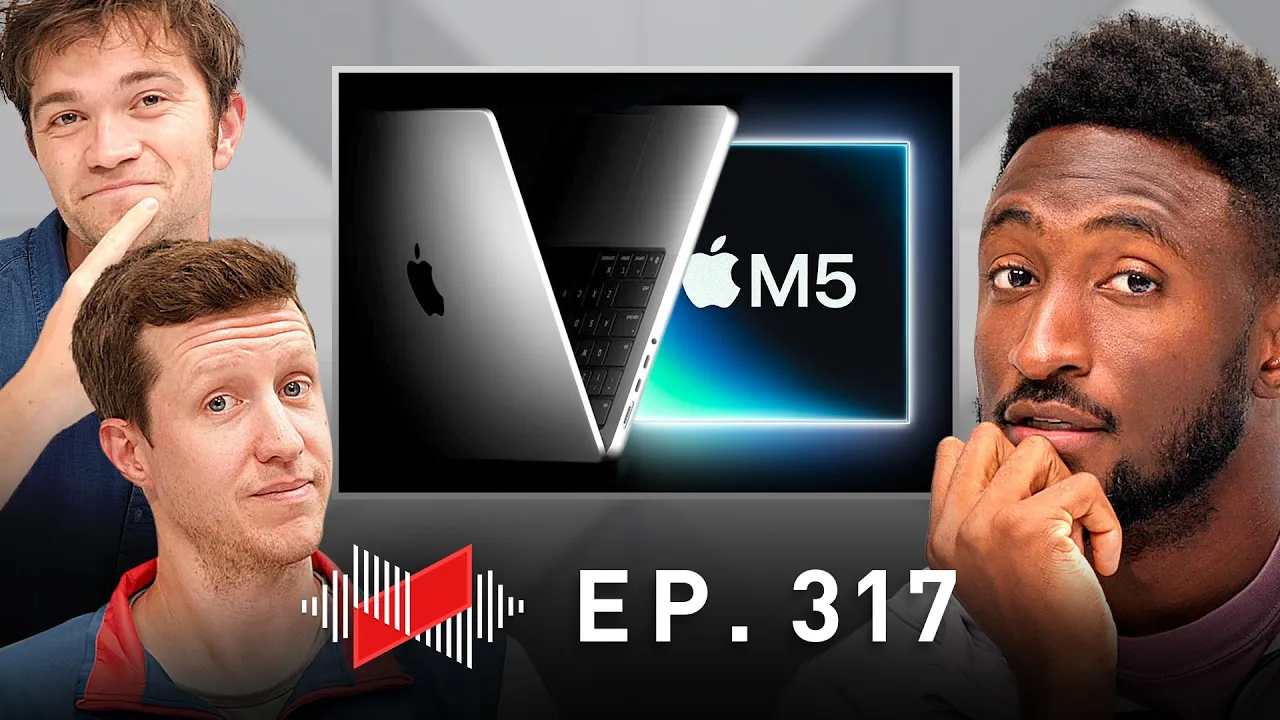
Goodbye Windows 10, Hello Apple M5 Chip!
Your rating
Reactions
AudioEnglish (original)Auto-dubbed: Dutch, French, German, Spanish, Arabic, Bangla, Hebrew, Hindi, Indonesian, Italian+8 more
Promos
It was a jam-packed week of news this week. Marques, Andrew, and David start it off talking about the new YouTube collab feature before discussing the Xiaomi 17 Pro. After that, they talk about the new Apple M5 products, Netflix and Spotify teaming up for podcast distribution, and of course the end of Windows 10 (kind of?). Then they wrap it up with the Pixel 10 Pro Fold exploding in the newest JerryRigEverything video and an Honor concept phone. Enjoy! Chapters: 00:00 Intro 01:02 Becca's video 07:57 Xiaomi 17 Pro 18:25 New Apple M5 products 34:37 Shopify (Sponsored) 35:39 Netflix and Spotify collab 42:21 Samsung event next week 45:26 Farewell Windows 10 57:19 LinkedIn (Sponsored) 58:18 Framer (Sponsored) 01:00:00 JerryRigEverything Pixel 10 Pro Fold 01:08:39 Honor AI concept phone 01:13:48 Trivia 01:18:47 Outro Becca Farsace - One year on YouTube: youtu.be MKBHD - Xiaomi 17 Pro: youtu.be JerryRigEverything - Pixel 10 Pro Fold video: youtu.be Honor concept phone: theverge.com This episode brought to you by: Shopify: shopify.com LinkedIn: linkedin.com Framer: framer.com (code: WAVE) Music provided by Epidemic Sound Shop the merch: shop.mkbhd.com Social: Waveform Threads: @waveformpodcast Waveform Instagram: @waveformpodcast Hosts: Marques: @mkbhd Andrew: @andrew_manganelli David: @davidimel Adam: @parmesanpapi17 Ellis: twitter.com TikTok: @waveformpodcast Join the Discord: discord.gg Music by 20syl: bit.ly Waveform is part of the Vox Media Podcast Network.
AI Overview
The hosts open with Becca Farsace’s recap of her first year as a full-time creator, including how she earns money through YouTube monetization and brand deals. They then explain how YouTube’s collaboration feature can distribute a video to collaborators’ audiences and subscription feeds, and discuss why some MKBHD viewers objected when podcast and studio content appeared in their feed. The conversation turns to the Xiaomi 17 Pro Max, praised for its large battery, fast charging, rear display, and strong overall hardware, while its camera processing and close resemblance to Apple’s design and software receive scrutiny. The hosts also compare Honor’s Magic OS 10 teaser with Apple’s Liquid Glass visuals and discuss how familiar designs can make competing phones feel more approachable.
Topics · apple · android · mac · podcast · smartphones · operating systems · consumer electronics
Questions answered
- What does YouTube’s collaboration feature do for a video?
- A collaborator’s audience may see the video in recommendations, and accepting a collaboration can also place it in that creator’s subscribers’ feeds. Collaborators can share access to video analytics.
- Which devices received Apple’s M5 chip in this announcement?
- The M5 was announced for the iPad Pro, the base 14-inch MacBook Pro, and the Vision Pro.
- What changes does the M5 Vision Pro bring?
- It supports rendering more pixels, up to a 120 Hz refresh rate for the view of the surroundings, and slightly improved battery life. Apple also introduced a dual knit band with support around the back and top of the head.
- Why are some computers still running Windows 10 after its support ended?
- Some devices cannot meet Windows 11’s hardware requirements, while organizations may avoid upgrades because of software compatibility, specialized equipment, sensitive data, or the cost of replacing working computers.
- Why did the Pixel 10 Pro Fold battery catch fire in the durability test?
- The hosts discussed the possibility that bending pressure pinched the edge of the battery near the antenna line, causing an internal short and thermal runaway. They described this as a possible explanation for the test incident, not as evidence that ordinary use commonly causes the phone to catch fire.
- What is unusual about Honor’s concept phone camera?
- The concept places a motorized, gimbal-style camera in the phone’s camera area. The camera can rotate and move into position, including for selfies, though the hosts noted that the concept’s practicality depends on fitting the mechanism into a phone-sized body.