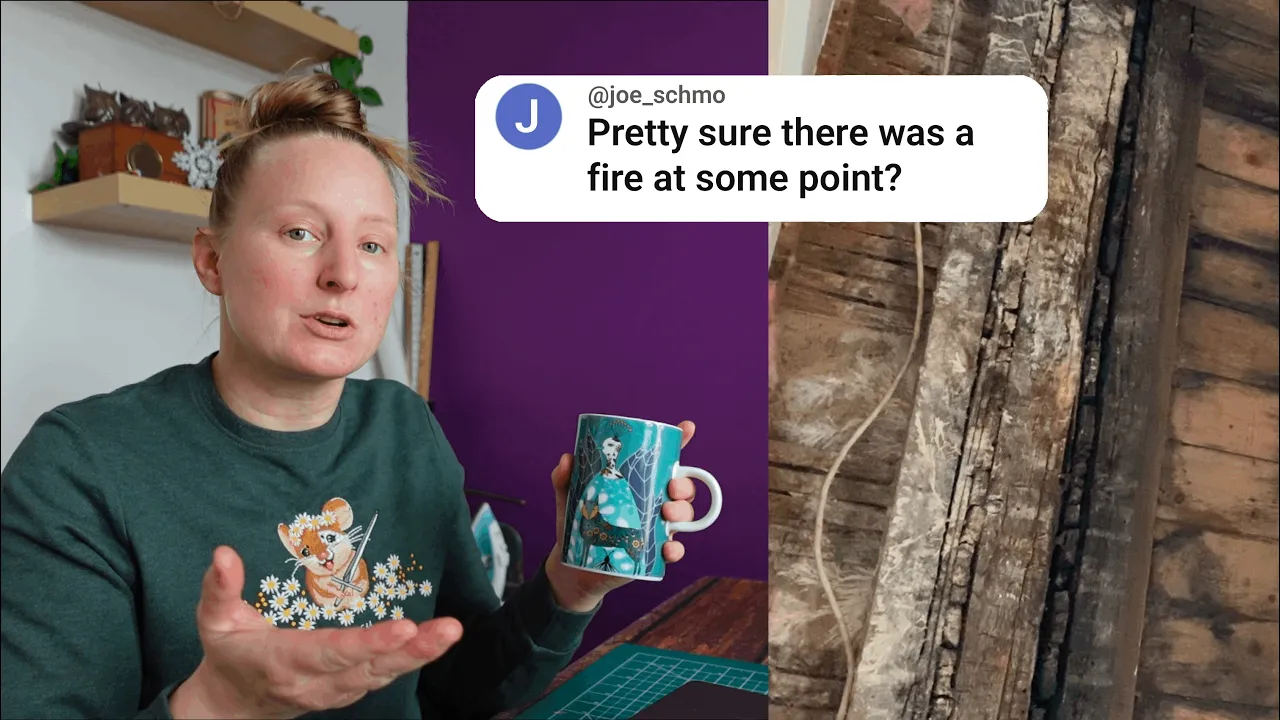
A fire at the house, mystery siding and malicious renovations... a debrief
Your rating
Reactions
Promos
Discover your perfect Mills Daily Pack! Order now at millsdailypacks.com and use my link to get started today and use my coupon code SHANNON10 Second Channel: @shannonmakessomethingelse HOUSE RENO PLAYLIST: youtube.com Patreon (monthly support): patreon.com Ko-Fi (one time tips & online store): ko-fi.com The 'Gram: @ShannonMakes Facebook: @ShannonMakesYT -------------------------------------------- OTHER WAYS TO SUPPORT THE HOUSE PROJECT Sage Restoration gift card: I will be frequenting this seller of historically appropriate supplies, materials & tools for things such as properly repointing my basement with lime-based mortar, and I just found out that they offer electronic gift cards!! → sagerestoration.com → my email address is makingseamsmeet @gmail.com CANADIAN Home Depot gift card: → homedepot-ca.cashstar.com → select "Digital Card" and my email address is makingseamsmeet @gmail.com AMAZON WISH LIST: Canadian Version: amazon.ca
Channels and socials
My email, if you want to do a gift certificate instead: makingseamsmeet @gmail.com →Amazon alternative: thegiftcardshop.com →Amazon gift card: go to amazon.com and type in "Amazon.com eGift Card" Please note that while I know it's a pain in the butt to create an Amazon.ca account, it is infinitely more useful to me to have a gift card that I can use on the Canadian amazon account, because I am very limited in the size, weight, and contents of things I can buy on Amazon.com and physically carry over the border HOUSE RENO PLAYLIST: youtube.com
AI Overview
This renovation debrief answers viewer questions about damage and earlier work on a century-old house. The dark, cube-shaped wood was not evidence of a fire: the host identifies it as cuboidal cracking caused by dry rot, with some timber also darkened by active moisture or other damage. The entryway was part of the original building, supported by the shape of the original foundation beneath it. The host says a wood sill at the side opening suggests it was framed for a window rather than a doorway, though the original appearance will be discussed in a future episode. She also notes that a window was present there when she bought the house, but cannot confirm it was original. The host asks viewers to avoid assuming that earlier renovations were malicious or deliberately cheap, saying that people may have followed advice about vapor barriers without understanding how a whole-house envelope works. She notes that vapor barriers can harm some older houses, and that building codes and suitable construction methods vary. In response to suggestions to demolish the house, she explains that parts in good condition are not usually shown on camera and that the house was built to be maintained and repaired. She points to its quality materials, construction, and age as reasons it has value beyond its financial worth. The debrief concludes with support for restoring and repairing items rather than throwing them away.
Topics · people & blogs · home renovation · historic preservation · home maintenance
Questions answered
- Did a fire cause the dark, cube-shaped wood in the house?
- No. The host identifies the cube-shaped cracking as dry rot, with some wood darkened by active moisture or other damage.
- Was the house's entryway added after the original construction?
- The host says the entryway was original, citing the original foundation footprint and its support for the entryway.
- Were the openings beside the entryway originally doorways?
- The host says the wood sill and framing are consistent with a window rather than a doorway, but cannot confirm the full original design.
- Why can vapor barriers cause problems in older houses?
- A vapor barrier can be unsuitable for a particular house envelope and climate, potentially contributing to damage when moisture behavior is not properly understood.
- Why does the host support repairing the century-old house instead of demolishing it?
- She says the house was built with quality materials and construction techniques for maintenance and repair, and that its age and historical character give it intrinsic value.


