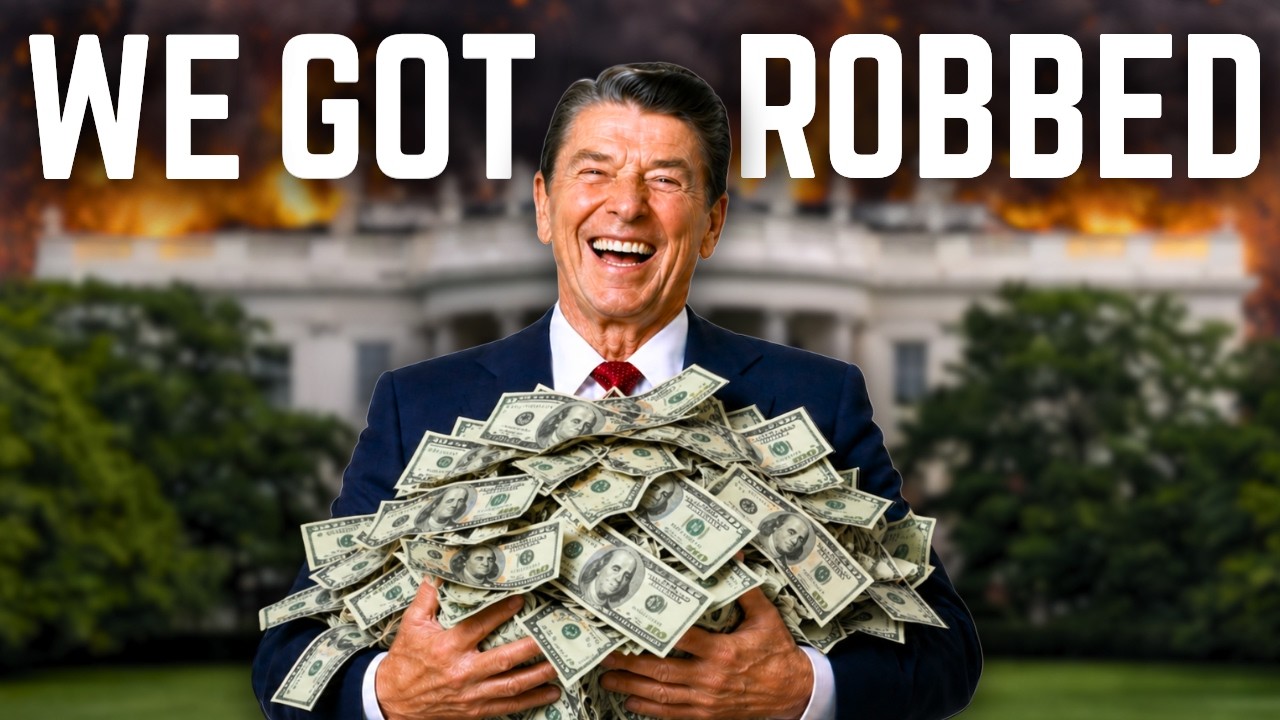
Ronald Reagan: The Man Who RUINED America
Your rating
Reactions
AudioEnglish (original)Auto-dubbed: Dutch, French, German, Spanish, Arabic, Bangla, Hebrew, Hindi, Indonesian, Italian+10 more
Description
Ronald Reagan SOLD OUT Americas Future. Be Apart Of My Growing Community On Patreon: patreon.com Ronald Reagan entered office during a period of rising inflation, economic uncertainty, and growing distrust in American institutions. As conversations surrounding the cost of living crisis, wealth inequality, and the collapse of the middle class continue gaining traction, discussions around Reaganomics, trickle down economics, and corporate deregulation are becoming impossible to ignore. At the same time, younger generations are facing rising housing costs, stagnant wages, record debt, and one of the most difficult entry level job markets in decades. With the rise of billionaires, corporate consolidation, and shareholder driven business models, the American economy has transformed faster than many people realize. While these changes promised economic growth, innovation, and greater opportunity, they also raised deeper questions surrounding wage stagnation, declining worker power, outsourcing, and the long term stability of the working class. Gen Z is now entering an economy defined by automation, AI disruption, unaffordable housing, rising healthcare costs, and increasing financial instability, where the path toward homeownership and long term security feels further away than ever before. The growing discussion surrounding unemployment, layoffs, and the collapse of entry level jobs highlights another major piece of this crisis. Workers are facing increasing pressure as expectations rise while economic stability continues to decline. This shift is contributing to a larger conversation about the sustainability of the modern economy and the long term consequences for both millennials and Gen Z. As stable careers become harder to access, the impact on financial independence, family formation, and long term wealth building becomes more pronounced. At the same time, broader economic forces tied to inflation and the cost of living crisis are reshaping how Americans approach education, employment, and retirement. Financial stress, rising debt, and declining purchasing power are influencing nearly every aspect of everyday life. This creates a feedback loop where systemic pressure continues building across multiple layers of society, ultimately affecting how future generations prepare for adulthood and economic survival. The intersection of corporate influence, deregulation, media consolidation, and economic instability is creating an environment that extends far beyond politics. Discussions surrounding Ronald Reagan often focus on tax cuts, Wall Street, unions, billionaire influence, and government policy, but there is also a growing awareness surrounding how these shifts reshaped the broader culture of the United States. As these systems became more interconnected, the long term effects on wages, housing affordability, economic mobility, and public trust became increasingly difficult to separate from the modern American experience. Gen Z is entering a world that looks dramatically different from previous generations, including baby boomers, where the pace of technological and economic change continues accelerating while traditional systems are increasingly tested. The cost of living crisis is no longer just an economic issue but a broader reflection of political decisions, corporate influence, and shifting national priorities. As conversations surrounding Ronald Reagan, wealth inequality, billionaires, unemployment, inflation, and the future of the American economy continue evolving, the focus remains on understanding how these forces intersect and what they mean for the future of the working class. #financialeducation #financialfreedom #history 0:00 Intro 0:24 Is Ronald Reagan To Blame For Everything Wrong With America? 0:47 Ronald Reagan Was ACTUALLY Raised A Democrat 1:19 Why FDR Was Ronald Reagans Childhood Hero 2:25 Ronald Reagan Was VERY Active In Pro Labor Politics 3:10 The Price Is Took Ronald Reagan To SELL OUT 4:42 Why Neoliberalism TOOK OVER America 5:34 Why Ronald Reagan Became The Face Of The Baby Boomer Generation 6:02 How Ronald Reagan Destroyed Unions 6:44 Trickle Down Economics... 7:37 How Ronald Reagan Ushered In The Subprime Loan 7:58 Why Stock Buybacks Have Exceeded 1 Trillion Dollars... 8:18 How Student Loans Became Big Business 8:46 How Ronald Reagan BROKE Entry Level Jobs 9:18 The WORST Thing Reagan Did 10:02 How Ronald Reagan Destroyed The Fairness Doctrine 10:55 Why It's Been So Hard To "Fix" What Reagan Did 12:24 How In The World Are People Defending Billionaires??? 14:27 Is America Beyond Repair? 16:33 Why Are Millennials So Underrepresented In Government? 18:28 Gen Z Is Also The Ones DESTROYING Entry Level Jobs Titles for the Algo! Ronald Reagan: The Man Who RUINED Everything Did Ronald Reagan ACTUALLY Ruin America How Ronald Reagan Ruined Everything Is Ronald Reagan To BLAME For Americas Decline How Ronald Reagan DESTROYED The Job Market
AI Overview
The video argues that Ronald Reagan was not solely responsible for America’s economic and political problems, but that his presidency accelerated a shift toward tax cuts, deregulation, weaker labor protections, and corporate influence. It traces Reagan’s early life in a Democratic household, his admiration for Franklin D. Roosevelt, and his work as a labor leader in the Screen Actors Guild. It then describes how his relationship with General Electric and its executive Lemuel Boulware helped move him toward pro-business politics. After becoming president, Reagan fired more than 11,000 striking air traffic controllers and signed tax legislation that substantially reduced the top marginal tax rate. The video connects these policies to widening wealth inequality and argues that the promised benefits of trickle-down economics did not reach most workers. It also acknowledges that other presidents and later political leaders contributed to the changes it criticizes.
Topics · education · economy · american politics · labor unions · economic inequality · media regulation
Questions answered
- What is the video’s main argument about Ronald Reagan’s impact on America?
- It argues that Reagan was not the sole cause of America’s problems, but that his presidency accelerated policies and changes that weakened labor protections and social safety nets while strengthening corporate influence.
- How did the Reagan administration respond to the PATCO strike?
- Reagan fired more than 11,000 striking air traffic controllers in 1981, an action the video presents as a major signal of declining support for organized labor.
- What does the video say Reaganomics did to taxes and wealth inequality?
- It says tax cuts sharply lowered the top marginal income tax rate and argues that the benefits disproportionately went to higher earners, while wealth inequality increased.
- What economic changes does the video connect to the Reagan administration?
- It links the administration to savings and loan deregulation, legal protections for corporate stock buybacks, and changes to grants and student loans that shifted more college costs onto students.
- What does the video say about Reagan-era media policy?
- It says the repeal of the Fairness Doctrine in 1987 removed a requirement for balanced broadcast coverage and contributed to partisan talk radio and cable news.


