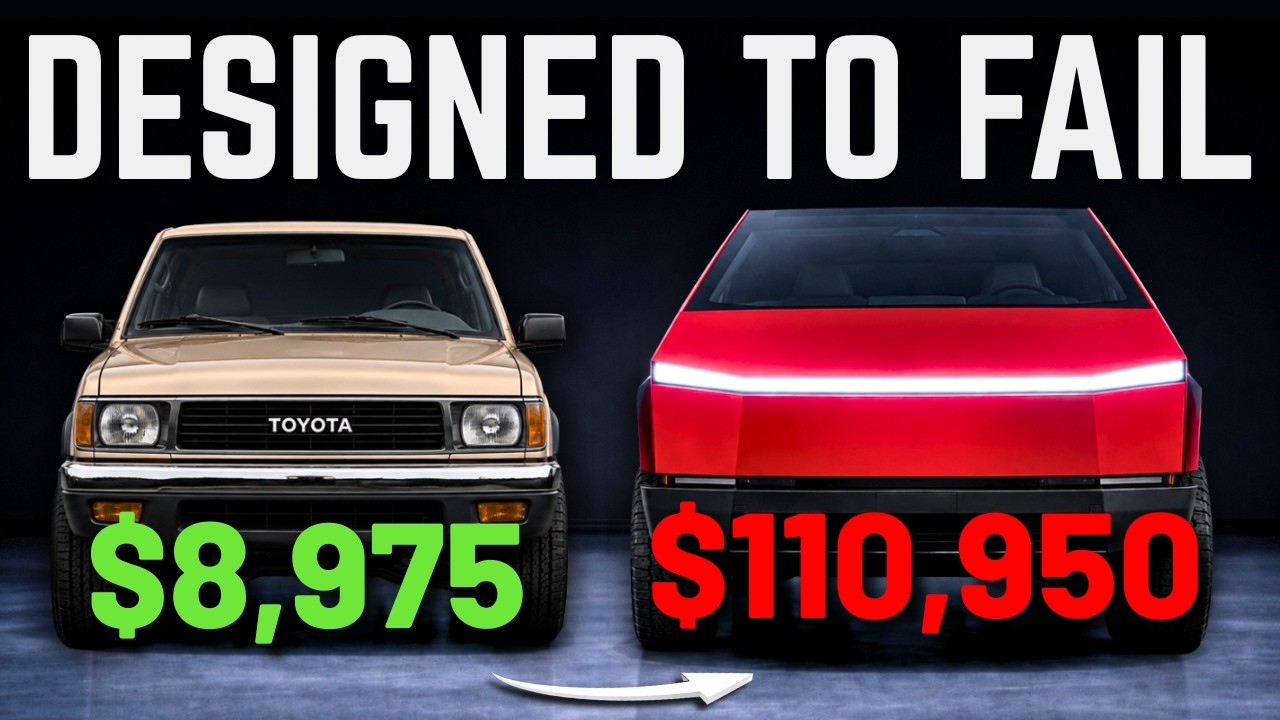
The Car Market KEEPS Getting Worse
Your rating
Reactions
AudioEnglish (original)Auto-dubbed: Dutch, French, German, Spanish, Arabic, Bangla, Hebrew, Hindi, Indonesian, Italian+10 more
Promos
The Car Market Is NOTHING More Than Expensive Junk. Modern cars are becoming increasingly software dependent as the car market rapidly shifts toward artificial intelligence, touchscreen ecosystems, autonomous driving systems, subscription based features, and increasingly complex vehicle technology. At the same time, the average car payment continues to rise during an ongoing cost of living crisis, leaving more drivers trapped between expensive repairs, rising insurance costs, and long term car loans. As concerns surrounding the auto loan crisis and the future of the car market continue to grow, conversations around planned obsolescence, vehicle reliability, dealership practices, and software driven design are becoming impossible to ignore. The modern car industry has transformed dramatically from the era of simple mechanical systems and long term ownership into a market increasingly centered around software updates, recurring subscriptions, and connected vehicle ecosystems. Artificial intelligence is now being integrated directly into the development of modern vehicles, accelerating engineering workflows, autonomous driving systems, infotainment systems, and vehicle software itself. As ai and artificial intelligence continue reshaping the automotive industry, questions surrounding reliability, maintenance costs, repair complexity, and long term ownership are becoming more relevant than ever before. The car market is also facing mounting economic pressure as rising car prices, expensive car loans, and increasing repair costs collide with broader fears surrounding a potential car market crash. The growing dependence on auto loans has fundamentally changed the relationship between consumers and vehicle ownership, with longer financing terms, larger monthly payments, and rapidly depreciating vehicles placing increasing strain on drivers. As the cost of maintaining modern cars rises, many consumers are finding themselves forced back into the dealership ecosystem for increasingly expensive repairs tied directly to software systems, sensors, and proprietary technology. At the same time, touchscreen infotainment systems, autonomous driving technology, and software controlled vehicle functions are rapidly replacing many of the simple and intuitive controls that once defined the driving experience. Modern vehicles are increasingly being designed around digital integration, data collection, and recurring monetization opportunities rather than simplicity and long term durability. This shift has fueled larger conversations surrounding planned obsolescence, anti repair engineering, subscription based vehicle features, and whether modern cars are truly improving the ownership experience itself. The rise of oversized SUVs, pickup trucks, autonomous driving systems, and connected vehicle platforms has also dramatically reshaped the broader car market. As automakers continue prioritizing software integration, ai development, autonomous systems, and recurring subscription revenue, concerns surrounding vehicle reliability, repair costs, distracted driving, and long term ownership continue to intensify. The future of the automotive industry is increasingly becoming a conversation about artificial intelligence, shareholder incentives, software ecosystems, and the growing disconnect between what drivers actually want and what the modern car market is becoming. #financialfreedom #financialeducation #history 0:00 Intro 0:22 Why The Economy Was Built Around The Car Market 0:36 How Planned Obsolescence Destroyed The Car Market 1:52 People Can No Longer Afford To Repair Their NEW Cars 2:34 Why Americans Buy SO MANY New Cars 3:12 How Japanese Manufactures Took Over The Car Market 4:09 Comparing American Car Reliability In 1976 Vs Japanese Cars 4:26 The Car Market Would Be THRIVING If Modern Cars Weren't Junk 4:55 What Caused The Golden Age Of Modern Cars Between 1990-2007? 5:42 The Car Market Is NOT Made For The Driver 6:07 Why Modern Cars Have SO MUCH Unnecessary Tech 6:47 Yep… AI Is Writing Code For Cars And Designing Them Too 7:45 Autonomous Driving Features Are NOT Safe 8:31 Why Every Car Has A Touch Screen 9:09 Turns Out Touch Screens Are VERY Distracting 9:50 Why Every Car Is GINORMOUS Now 10:17 Modern Headlights Are HORRIBLE 10:35 The Car Market Is Just One Big Monthly Subscription 11:19 Modern Cars Are Surveillance Machines 11:51 The BEST New Car Feature Of All Time 14:12 Range Rovers And Their Door Handles Are My Worst Enemy 15:23 AI Will Be Mandated To Track Us In Our Cars By 2027 18:46 Whatever You Do AVOID Buying A New Car Titles for the Algo! Modern Cars Are Becoming WORSE On Purpose Modern Cars Are COMPLETE Junk Why Moderns Cars Are Getting Worse In 2026 Modern Cars Are Getting WORSE In 2026
AI Overview
The video argues that car ownership is becoming less affordable and modern vehicles are harder to repair. It cites an average new-car price above $50,000, a typical monthly payment just under $800, and rising repair and maintenance costs. It traces the industry’s focus on frequent upgrades and auto loans to General Motors executive Alfred P. Sloan, contrasting that approach with Henry Ford’s emphasis on long-lasting, accessible cars. The video then compares American manufacturers’ historical quality problems with Japanese automakers’ focus on reliability and fuel efficiency. It describes the 1990s and early 2000s as a period when reliability, simplicity, and driver-focused design briefly came together. Its broader conclusion is that automakers increasingly prioritize financial returns over what drivers want from their cars.
Topics · automotive industry · cost of living crisis · economy · technology
Questions answered
- How expensive are new cars and their monthly payments in the figures cited?
- The video cites an average new-car price above $50,000 and a typical monthly payment just under $800. It also says nearly 20% of borrowers have monthly payments of at least $1,000.
- What does planned obsolescence mean in the history of the car industry?
- The video describes Alfred P. Sloan’s strategy of encouraging frequent upgrades through styling changes and auto loans, rather than focusing only on making cars accessible and long-lasting.
- How is artificial intelligence being used to develop cars?
- The video says General Motors CEO Mary Barra stated that AI generates nearly 90% of the code written by GM’s autonomy team, including work for a planned next-generation version of Super Cruise.
- Why does the video criticize touchscreen controls in cars?
- It argues that touchscreens can be distracting and harder to use than physical controls. It cites a study in which programming navigation took about 40 seconds on average, and says automakers also use screens to reduce parts and enable software updates and subscription features.
- What approach to car repairs does the speaker recommend considering?
- The speaker encourages drivers to compare a repair bill with the ongoing cost of a new-car payment before replacing a vehicle. As an example, the speaker describes obtaining a replacement door for a 2007 Ford Focus from a junkyard for $700.


