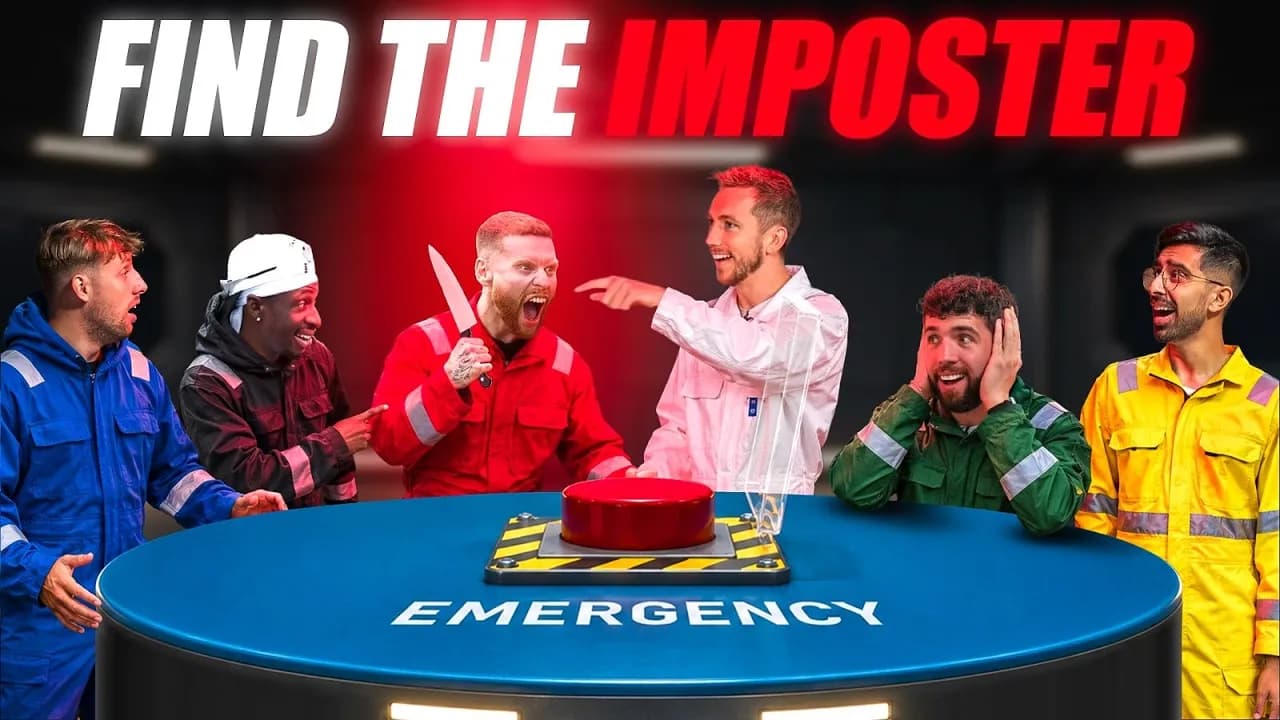
SIDEMEN AMONG US BUT IF YOU REPORT A BODY YOU DIE
Your rating
Reactions
Description
Channels and socials
Watch Side+ FREE with 3-Day Free Trial: sideplus.com : Order food NOW at: eatsides.com : XIX Vodka: xixvodka.com : Subscribe to our Reacts Channel: youtube.com
: Sidemen Clothing: sidemenclothing.com : Sidemen Instagram: @Sidemen : Sidemen Twitter: twitter.com Hot House Games: hothousegames.com SIDEMEN JOSH (Zerkaa)
● @Zerkaa
● twitter.com Edited by @chipfat
AI Overview
The Sidemen start an Among Us session with a mystery role and initially struggle to understand what it does. Early clues suggest that reporting certain bodies can kill the reporter, and Vikkstar’s death after a report leaves the group unsure whether he triggered the effect or was killed in another way. Players debate suspicious behavior, custom skins, and who may have placed a decoy, while the role’s rules remain unclear. The first stretch sets up a round built around fake bodies and the danger of reporting them. As more strange body appearances occur, the players try to connect deaths to the secret role and accuse one another based on where they were and what they were doing. A report kills more players, strengthening the theory that the mystery ability punishes people who report a decoy. Meanwhile, conversation about task counts and who has finished their objectives creates additional suspicion. The lobby still has not fully worked out the role’s exact mechanics. The group continues trying to complete tasks while tracking suspicious movement and possible kills. An oxygen emergency and a sudden death lead to discussion about a delayed effect, with players considering whether a sheriff ability or the mystery role caused the death. Accusations shift between players who ran from the emergency and those whose whereabouts are uncertain. The round remains difficult to read because the players have little shared evidence. In the following discussions, players revisit earlier deaths and try to determine which bodies were real and which were decoys. Some players suspect that someone is deliberately baiting reports, while others focus on task progress and who was near a body. A sheriff shot is attempted amid the confusion, and the group debates whether a death happened instantly or after a delay. The arguments expose how hard it is to reason about the role without knowing its rules. A further round brings more accusations, including suspicions around players who join cameras or avoid reporting a body. The players discuss whether staying near others is a sign of innocence or an attempt to cover tracks. One player admits that companionship and wanting to feel involved influenced their movements, adding to the comic distrust. The discussion ends with the group still weighing several possible explanations rather than agreeing on a clear suspect. The pressure rises when players try to identify the impostor while tracking the decoy-body mechanic. Harry and others debate who was present when a body appeared, and a sheriff attempt becomes part of the confusion. A player is blamed after another character dies nearby, but the group cannot establish whether the death was caused by the special role. The meeting turns into a back-and-forth over whether the evidence points to Josh, Jack, or someone else. After the first major sequence, the player with the body-swapper role explains that they can place proxy bodies and that reporting one causes the reporter to die. They describe using decoys to bait players rather than relying only on ordinary kills, and the others react to how powerful the tactic can be. The session then moves into another game with different roles and two impostors. Players again have to work out which odd deaths and body appearances are caused by abilities rather than normal kills. In the next round, the body-swapper deliberately places decoys around the map and expects players to become wary of reporting any body. Several players encounter bodies and debate which ones are real, while emergency events and movement around the airlock create more confusion. The group tries to compare body colors and locations, but the role allows the decoy’s appearance to mislead them. A player also describes being killed after reporting a body, reinforcing the danger of acting on incomplete information. The group shifts attention to Toby after a player is silenced and the others discuss a blackmail ability. One player blurts out an accusation before the meeting fully develops, making the group question whether the silence itself is evidence. They debate the location of a body and whether Toby had a reason to silence someone, while the accused insists the group has misread the situation. The meeting ends with players arguing about whether they have learned anything from previous mistakes. Another round features a sheriff role and a death that players interpret in different ways. Harry reports seeing a suspicious event, and the group tries to decide whether to trust his account or treat it as another misleading interaction. The discussion includes confusion about how the sheriff role is earned and whether a player was close enough to cause the death. Later, a decoy body creates another argument over who placed it and whether a player’s explanation makes sense. Players celebrate a crew victory after identifying both impostors in one round, though they joke about how chaotic the deductions were. They then introduce more roles, including a prosecutor who can choose someone to exile, and discuss how task completion can unlock or affect roles such as sheriff. Another game starts with guesses about who the impostors might be, but the players quickly return to uncertain reads and risky decisions. The shifting abilities keep changing what counts as reliable evidence. A sheriff makes a risky move and dies, prompting the group to argue over whom the sheriff targeted and what that result proves. Harry is discussed as potentially cleared, but players remain wary because they disagree about what they saw. The body-swapper mechanic continues to complicate reports, and someone points out that they reported a body without dying. This reinforces that not every body in the game is necessarily a decoy and that players cannot use one simple rule to identify the culprit. The group later debates a body near the lower engine and whether Toby blackmailed another player. Players give conflicting accounts of who was present, while accusations and interruptions make the meeting increasingly heated. A prosecutor uses their ability to exile a player, but the decision leaves the rest of the group unsure whether it was based on a deliberate read or a mistake. The players then reconsider earlier clues and speculate about whether the impostors can still win together. In the late game, players argue over a possible vent sighting and whether Harry or Toby is responsible for a kill. They repeatedly revisit an earlier sheriff event, with some players treating it as a clear alibi and others suspecting that it may have been staged or misread. Confident but conflicting claims lead to a vote that does not settle the dispute cleanly. The disagreement becomes a running joke as the group tries to reconstruct what each person actually saw. The final stretch is dominated by players reacting to the round’s mistakes and defending their interpretations. Jack says he thought he saw Toby kill, while Harry does not reveal that he has an Engineer role, leaving the group without a useful explanation for the vent sighting. The players realize too late that sharing that information could have clarified the situation, and they call the round one of their worst Among Us games. The session ends on that chaotic failure, with the group agreeing that the confused deductions make a memorable finish.
Topics · sidemen · entertainment · among us · gaming · comedy · challenge
Questions answered
- What does the body-swapper role do in Among Us?
- The body-swapper can place proxy or decoy bodies, and a player who reports one dies.
- Why are the players reluctant to report bodies?
- They suspect some bodies are decoys that kill whoever reports them, so they cannot assume every body is safe to report.
- What role can exile a chosen player?
- The prosecutor can choose a player to exile.
- How does the final round end?
- The players make conflicting deductions about a kill and a possible vent sighting, then realize that failing to share role information made the confusion worse.