Your rating
Reactions
Promos
Watch the full WAN Show: youtube.com ►GET MERCH: lttstore.com ►SUPPORT US ON FLOATPLANE: floatplane.com AFFILIATES & REFERRALS --------------------------------------------------- ►Check out our podcast gear: kit.co ►Affiliates, Sponsors & Referrals: lmg.gg ►Private Internet Access VPN: lmg.gg ►MK Keyboards: lmg.gg ►Nerd or Die Stream Overlays: lmg.gg ►Amazon Prime: lmg.gg ►Audible Free Trial: lmg.gg ►Our Gear on Amazon: geni.us FOLLOW US ON SOCIAL --------------------------------------------------- Twitter: twitter.com Facebook: @LinusTech Instagram: @linustech Twitch: twitch.tv FOLLOW OUR OTHER CHANNELS --------------------------------------------------- @Linus Tech Tips @TechLinked @Techquickie @Mac Address @ShortCircuit @Carpool Critics @Channel Super Fun
AI Overview
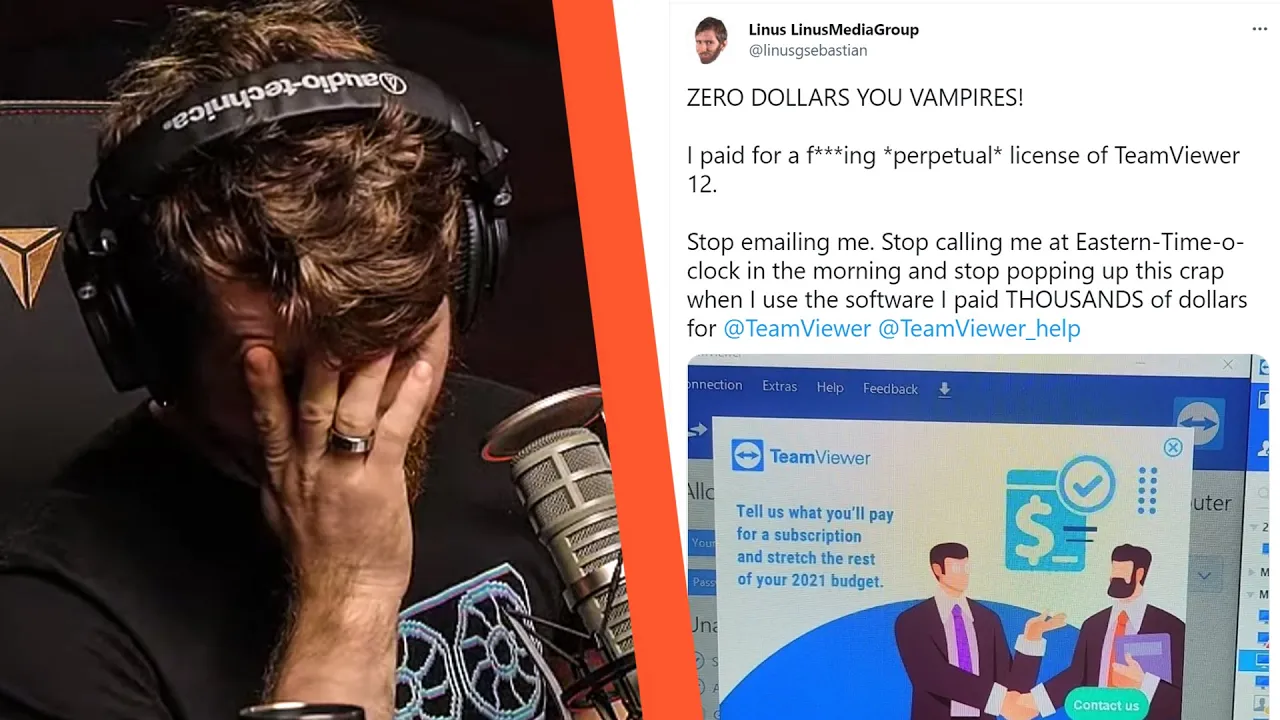
The speaker explains that he opened TeamViewer to reach his work computer while testing whether Parsec could stream games that were unplayable on Linux. He had bought a perpetual TeamViewer 2012 license for more than $5,000, then saw TeamViewer move to a subscription model and stop selling perpetual licenses. TeamViewer had repeatedly contacted him by email, phone, and in-product pop-ups to encourage an upgrade, even though he had told the company to stop and already had the features he needed. He says TeamViewer remains useful for remote script reviews, including working with John on the same virtual machine, but he had no reason to switch plans. Frustrated by another pop-up while trying to install Parsec, he posted an angry tweet about the repeated sales messages. The speaker says many people responding to the tweet also disliked TeamViewer’s marketing, and some suggested using a setting to hide the pop-ups. TeamViewer support replied with instructions to disable in-product marketing messages, but the speaker could not find the setting because, as he discovered, it was only available in subscription versions. He points to this mismatch as the reason the pop-up’s “don’t show this message again” option had not stopped the messages. TeamViewer later called and said his account had been marked to stop receiving them. The speaker objects that this response only fixes the problem for him after his public complaint, rather than addressing the experience of all perpetual-license customers. The closing argument is that TeamViewer should stop marketing to every customer who has already paid for a perpetual license, not make a special exception for a YouTuber. The speaker says the company’s individual accommodation demonstrated that it knew how to suppress the messages but had not done so for other customers. He briefly raises the possibility of a complaint under CAN-SPAM, while saying that pursuing it probably would not be worth the effort. He frames the episode as evidence of poor customer treatment and says that doing the right thing for him should mean doing it for everyone. The segment ends with a joking call to clip and share the discussion, followed by a quip about being contacted by email or phone.
Topics · podcast · technology · business · opinion · clip
Questions answered
- Why did the speaker use TeamViewer while testing Parsec for Linux gaming?
- He used TeamViewer to access his work computer remotely so he could install Parsec and test streaming games to his Linux machine.
- Why did the speaker object to TeamViewer's subscription prompts?
- He had already paid more than $5,000 for a perpetual TeamViewer 2012 license, had the features he needed, and repeatedly asked TeamViewer to stop contacting him about upgrading.
- Why did TeamViewer's suggested setting not stop the marketing pop-ups?
- The speaker found that the setting TeamViewer support recommended was only available in subscription versions, not the version he used.
- What change did the speaker want TeamViewer to make for perpetual-license customers?
- He wanted TeamViewer to stop sending marketing messages to all customers with perpetual licenses, rather than only marking his account to stop receiving them.


