Your rating
Reactions
Promos
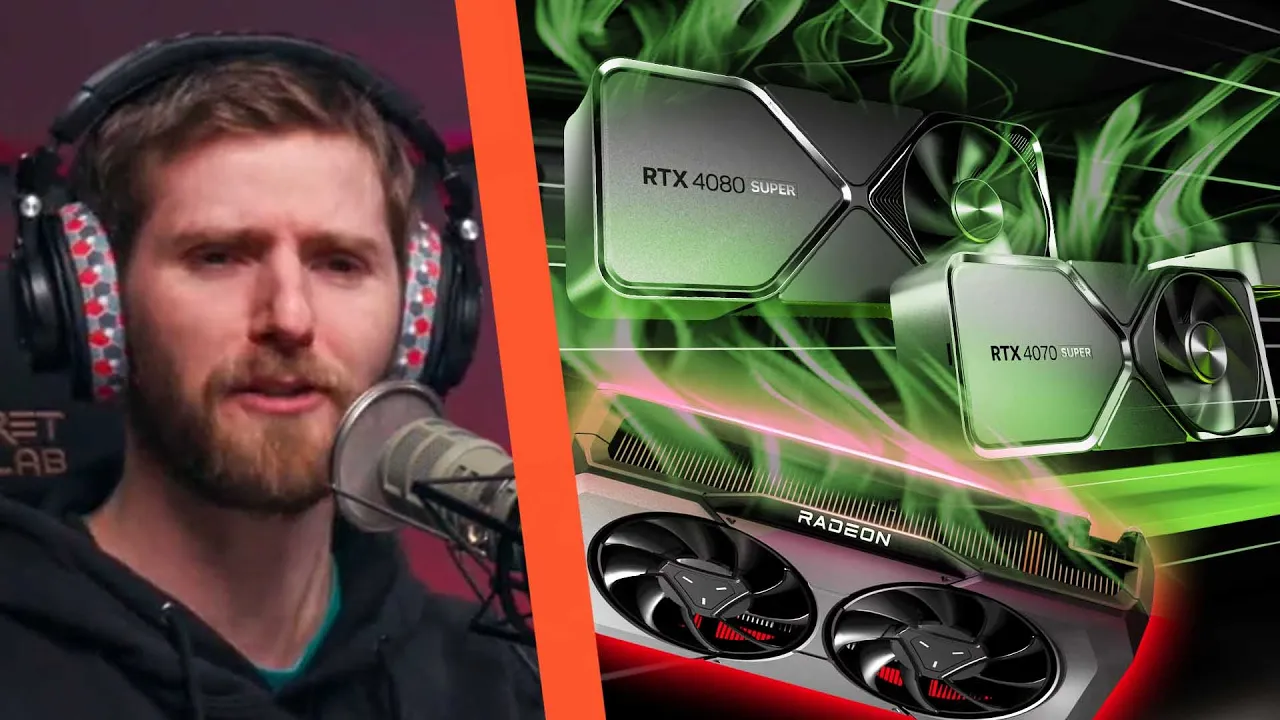
Linus and Luke discuss AMD and Nvidia’s new graphics cards. Watch the full WAN Show: youtube.com ► GET MERCH: lttstore.com ► GET EXCLUSIVE CONTENT ON FLOATPLANE: lmg.gg ► SPONSORS, AFFILIATES, AND PARTNERS: lmg.gg ► OUR WAN PODCAST GEAR: lmg.gg FOLLOW US ON SOCIAL --------------------------------------------------- Twitter: twitter.com Facebook: @LinusTech Instagram: @linustech TikTok: @linustech TikTok (LMG Clips): @_lmgclips_ Twitch: twitch.tv
AI Overview
Linus and Luke begin with AMD’s new AM4 processors, including a lower-cost X3D chip made from processors that did not meet the 5800X3D’s clock-speed targets. AMD’s claim, which Linus says they have not yet validated, is that the chip’s cache can preserve much of its gaming performance despite lower clocks. He sees a roughly $250 upgrade as appealing for the large number of AM4 owners who could keep pace with newer graphics cards without replacing their whole system. They then discuss AMD’s 8000G series and its integrated graphics, including demonstrations of demanding games running at around 60 frames per second with upscaling and frame generation. Linus says this performance changes his view of integrated graphics, which he once saw as a poor use of CPU space. He argues that capable integrated graphics make new, very low-end graphics cards difficult to justify, while a used card can be a better option for an older computer that needs an upgrade. The discussion turns to Nvidia’s graphics-card lineup and the argument that its product tiers leave buyers short on performance or video memory to encourage spending more. Linus criticizes the 4060 and 4060 Ti options as having trade-offs in speed, VRAM, and price, then points to the 4070 Super’s 12 GB of VRAM at $600 and the 4070 Ti Super’s 16 GB at $800. He notes that adding more memory to a 192-bit card presents design trade-offs, but argues that the overall pricing and lineup still make upgrades feel costly. Linus praises the 4080 Super’s 4K gaming performance, citing more than 100 frames per second in Call of Duty: Modern Warfare without upscaling and roughly 220 to 240 with it, as well as a $200 price reduction from the prior model’s launch price. He remains concerned that PC games may need more VRAM as developers work with the memory available on current consoles and PC players use higher detail settings. His broader conclusion is that buyers should be wary of graphics cards that seem under-equipped for their price, even when a more expensive tier appears to offer a better deal.
Topics · science & technology · hardware · gaming · pc · opinion · podcast
Questions answered
- Why does Linus advise against buying new entry-level graphics cards?
- He argues that integrated graphics can now run demanding games, while a used graphics card can be a better-value upgrade for an older computer.
- What is the proposed benefit of AMD’s lower-cost AM4 X3D processor?
- At around $250, it could offer gaming performance close to the 5800X3D by retaining the benefits of its cache despite lower clock speeds. AMD’s performance claim had not yet been validated by Linus.
- Why does Linus question the VRAM on some Nvidia graphics cards?
- He worries that cards such as the $600 4070 Super, with 12 GB of VRAM, may be constrained by increasingly demanding games and higher PC detail settings.
- How did the 4080 Super perform in Call of Duty: Modern Warfare?
- Linus reports more than 100 frames per second at 4K without upscaling and roughly 220 to 240 frames per second with upscaling and related features.


