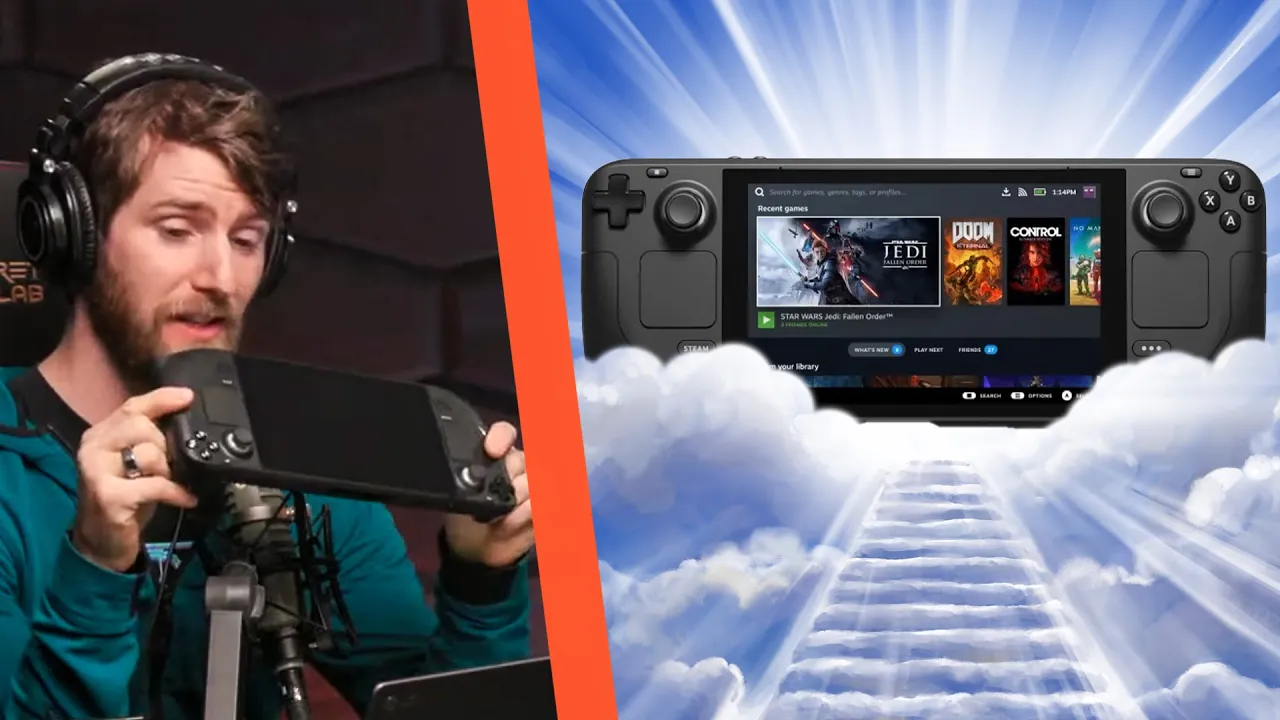
Our UNRESTRICTED thoughts on the Steam Deck
Your rating
Reactions
Promos
I can't wait to receive mine in 2024 Watch the full WAN Show: youtube.com ► GET MERCH: lttstore.com ► AFFILIATES, SPONSORS & REFERRALS: lmg.gg ► PODCAST GEAR: lmg.gg ► SUPPORT US ON FLOATPLANE: floatplane.com FOLLOW US ON SOCIAL --------------------------------------------------- Twitter: twitter.com Facebook: @LinusTech Instagram: @linustech TikTok: @linustech Twitch: twitch.tv
AI Overview
Linus and Luke discuss the Steam Deck after its official launch, weighing positive reviews against the device’s unfinished software. They praise the handheld interface, its integration with Steam, the performance overlay, the “Great on Deck” store section, and suspend and save-sync features. They also point to rough edges, including glitches, crashes, inconsistent navigation, and limited ways to find compatible games. Battery life at full performance is raised as a concern, while the Deck’s customizability and open-ended nature are presented as major strengths. Linus explains that he is using the Steam Deck as his only computer for a month, with remote play as a way to access games that do not run directly on the device. The hosts are impressed by the quality of Steam Remote Play and discuss practical details such as quickly closing games and seeing control prompts when launching Doom. They also note limitations: streaming from a 4K source to the Deck looked poor, and text was difficult to read. Linus says his initial review focused on the console-style gaming experience, while desktop use and emulation would have been other valid angles. The discussion turns to why the review was difficult to complete: Valve kept shipping software updates, sometimes every day, so compatibility and features could change during testing. Linus describes staying up overnight to shoot the review close to its release, and credits the production team for finishing additional work while he was away. Updates arriving shortly before launch added features including the “Great on Deck” page and switching between applications. The rapid pace made coverage challenging, but the hosts also saw it as evidence that the product was actively evolving and that Valve was responding quickly to technical problems. Linus and Luke praise the fast suspend-and-resume experience, then consider the Steam Deck as part of Valve’s longer-term strategy. Linus argues that Valve may be moving beyond being primarily a game storefront toward acting more like a console platform company, offering developers an install base for portable, controller-first games. He connects that idea to earlier Valve efforts including the Steam Controller and in-home streaming, later called Remote Play. Luke says his remaining concern is the thumbsticks, while Linus describes the Deck as a significant hardware launch that he wants to keep following. The conversation concludes with Linus saying he will keep his pre-order because he finds the hardware and its continuing updates unusually interesting. He calls the Steam Deck the most innovative PC he has seen in his two decades of following computer hardware, while clarifying that this is a judgment based on his own experience. Luke says he wants the device partly to experience what may be a historically significant launch. Their overall view is enthusiastic but qualified: the Deck has appealing hardware, flexibility, and platform potential, while its software and game compatibility were still changing at launch.
Topics · gaming · hardware · opinion · pc · podcast · science & technology
Questions answered
- What did Linus and Luke like about the Steam Deck's software and interface?
- They liked the intuitive handheld interface, its integration with Steam, the performance overlay, the “Great on Deck” store page, and the fast suspend-and-resume experience.
- What software problems did the Steam Deck have around launch?
- The hosts describe crashes and glitches, inconsistent navigation, limited ways to find compatible games, and features that were still being updated.
- How did Steam Remote Play work on the Steam Deck?
- The hosts found remote play impressively responsive, and Linus considered it a way to play games that were not directly compatible with the Deck. Streaming a 4K desktop to the 720p screen produced poor image quality and unreadable text in his test.
- Why did Linus say reviewing the Steam Deck was unusually difficult?
- Valve kept releasing updates during the review period, changing features and game compatibility, which made it difficult to assess and document a fixed software experience.
- What broader role did Linus think Valve wanted the Steam Deck to play?
- He viewed it as a step toward Valve becoming more of a gaming platform and console manufacturer, rather than primarily a digital storefront.


