The AI Bubble… We Need to Talk
Your rating
Reactions
AudioEnglish (original)Auto-dubbed: Dutch, French, German, Spanish, Arabic, Bangla, Hebrew, Hindi, Indonesian, Italian+7 more
Description
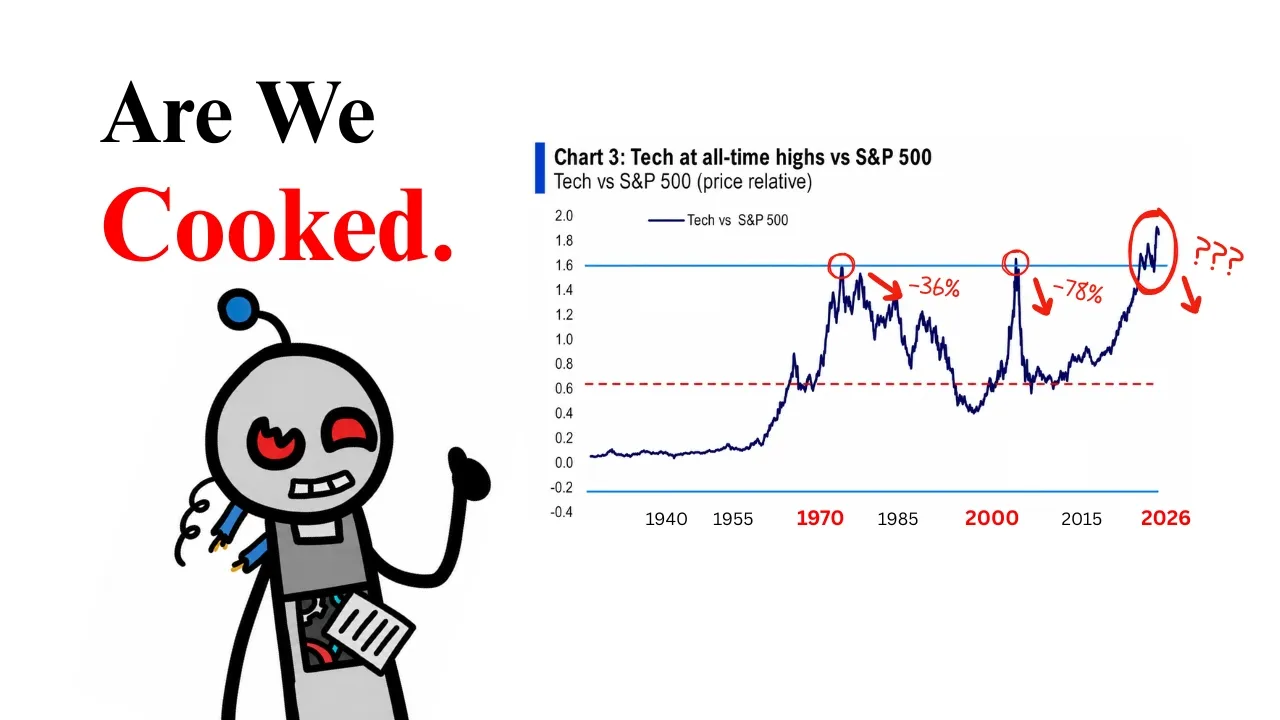
Half the internet says AI is the biggest bubble in history. The other half says it's the most important technology ever built.
Channels and socials
Check out Printful printful.com #Printful Whether AI is the future was never the real question. The real one is who gets rich and who gets wiped out. In this video, I'll break down: • The 200-year-old framework the world's best investors use to spot financial bubbles before they burst, and what it says about AI right now. • Why history's biggest financial bubbles were built on the best technology, not the worst. • Just how much Big Tech's projected $725 billion in AI spending really is. • What the capital cycle theory is and the four stages every financial bubble moves through. • Who quietly gets rich when the AI bubble bursts. If one video wasn’t enough, I post everyday here: @casuallyfinance All illustrations, visuals, and animations in this video are original and hand-drawn by a freelance artist. Disclaimer: The information provided in this video and on this channel (collectively, the “Content”) is for informational, educational, and entertainment purposes only and does not constitute investment, financial, legal, or tax advice, nor a recommendation to buy, sell, or hold any security or investment strategy. Investing involves risk and you must do your own research. Nothing in the Content should be interpreted as creating a fiduciary relationship, financial advisory relationship, or client relationship of any kind. The host, the channel, and all affiliated entities expressly disclaim any and all liability for any direct or consequential loss or damage arising directly or indirectly from the use of, reliance upon, or interpretation of the Content. By viewing or interacting with the Content, you acknowledge and agree to these terms and release the host and all related parties from any and all claims related to your reliance on the information provided.
AI Overview
The video argues that the AI debate focuses too heavily on demand, such as user growth and adoption, and not enough on capital committed to building supply. It cites projected Big Tech AI spending of about $725 billion in a year, then puts the scale in perspective as roughly $2 billion per day. The video says that major technologies can be genuinely useful and still fuel financial bubbles, citing research on 51 major breakthroughs, 37 of which were associated with speculative bubbles. Its central lens is the capital cycle, which tracks investment and productive capacity rather than relying on demand narratives.
Topics · business · economics · education · finance · financial markets · stock market
Questions answered
- What are the four stages of the capital cycle?
- The four stages are the flood, when investment pours into an industry; the boom, when competitors add capacity faster than demand grows; the collapse, when excess supply compresses returns; and the inheritance, when later buyers acquire assets left behind at lower prices.
- Why does the capital cycle focus on supply rather than demand?
- Capital commitments reveal how much capacity is being built, while demand figures and growth narratives can be noisy or distorted. Excess investment can increase competition and reduce returns even when a technology is useful.
- How can circular financing make AI demand look larger?
- When companies invest in customers or lend them money to buy equipment, the resulting purchases can be counted as sales even though financing supplied by sellers helped create the demand.
- What historical examples illustrate the capital cycle?
- The video describes British railway investment in the 1840s, excess fiber-optic construction in the late 1990s, and the shale oil boom followed by falling oil prices and company bankruptcies.
- Who can benefit after a financial bubble collapses?
- Later buyers may acquire useful assets built by companies that failed during the boom, at prices far below the original investment.