Best of the week in Finance
Ranked by views among the newest 7 days of videos that have a brief (the 7 days ending at the latest one). The list updates continuously and keeps the same address.
Videos
- 01 · Mario Lochner
The briefing examines whether the rebound in Nvidia and the wider market marks a genuine recovery or a bull trap. It presents bearish concerns including hotter-than-expected inflation readings, proposed US tariffs, export restrictions on Nvidia chips, and uncertainty around AI data-center projects. The bullish case points to strong US economic growth, low jobless claims, resilient consumer spending, and heavy investor pessimism after a sharp sell-off in chip stocks. The presenter urges investors to stay measured rather than panic or assume the rebound will continue.
- 02 · Los Ecomonos
The video explains how an initial public offering works through a fictional banana-sorting company. Moncho first sells 10% of his company to Don Banano, then seeks more capital to expand and launches an IPO at 100 green leaves per share. Large funds can receive shares at that initial price before public trading begins, while many small investors can only buy after trading starts. Strong demand pushes the share price to 150 and then 175, even though the company itself has not changed. The example shows how early allocations can create gains for some investors while later buyers pay a higher price. The video also explains lock-up periods, which often restrict early investors from selling for about 180 days, though the terms vary by IPO. Rivian is used as a real-world example: its shares rose after its 2021 debut, and the end of the lock-up period coincided with a sharp price decline, alongside production and cost problems. The video then discusses OpenAI's reported 2025 revenue of about 13 billion and expenses of about 34 billion, alongside a reported March 2026 valuation of 852 billion. It explains that investors may value a company based on hoped-for future profits, while warning that those profits may not materialize and that AI infrastructure is expensive. It also notes that Microsoft-like cloud services and Nvidia chips can absorb investment money, and concludes that investors should assess earnings, sellers, and whether a share price is justified.
- 03 · Mario Lochner
Host Mario Lochner interviews Christoph von Ende of the Huber von Ende family office about the difference between building wealth and preserving it. Von Ende argues that the habits that can help someone become wealthy, including concentration and risk-taking, can become dangerous after their financial goals are already met. He recommends defining a personal strategy around life plans and priorities before choosing investments. The discussion uses Nvidia and the possibility of an Anthropic IPO to illustrate how attention can shift with market hype. Von Ende says individual-stock risks are not reliably rewarded over the long term, so such investments should be limited rather than treated as a dependable wealth-building strategy. The guests discuss concentration in broad stock-market ETFs, including the weight of the largest companies in the MSCI World. Von Ende gives the top ten holdings as nearly 30% of that index, compared with about 22% for the MSCI ACWI IMI. He says investors seeking broader diversification could consider an MSCI ACWI IMI or FTSE All Cap fund, while keeping their overall portfolio simple. His family office limits the combined weight of the ten largest holdings in managed portfolios to 10%. Equal-weight ETFs are also discussed as one way to reduce the influence of the biggest stocks. The interview emphasizes that past investment success does not show that someone can reliably identify future winners. Von Ende cites the claim that about 4% of stocks generated the entire increase in US stock-market wealth, and questions whether those winners could have been identified in advance. He says that reinvesting a large fortune into one or a few stocks exposes the owner to substantial downside, even if the original investment performed exceptionally well. He also describes a financial “firewall” that can set aside enough assets to protect a desired standard of living if a business or concentrated investment fails. In his view, entrepreneurs can continue taking business risks while separating a secure portion of personal wealth from those risks. Concentration, borrowing, and excessive complexity are identified as major ways wealth can be lost. Von Ende explains that debt can turn a property-price decline into a personal bankruptcy risk, especially if lenders demand repayment during a downturn. He contrasts leveraged real estate with an unleveraged, diversified fortune, which he says is much harder to destroy through a market crisis alone. He also warns that numerous scattered investments can make it difficult to understand the risks in a household’s total wealth. Instead, he recommends starting with a clear overview of a person’s circumstances, responsibilities, goals, and desired standard of living. For people who sell a company or inherit money, Von Ende says investment decisions should come after the strategy is clear. He suggests keeping proceeds in high-quality, short-term bonds while planning, rather than rushing into the market under pressure from advisers or acquaintances. Liquidity should cover living expenses without leaving too much wealth in cash, and he discusses money-market ETFs for near-term needs and short-term high-quality bonds for later expenses. He describes a reference portfolio that can combine diversified securities, property, and precious metals, while cautioning that more holdings can also mean more work, costs, and complexity. He also highlights property transaction costs and the long-term effect of higher investment-management fees. The conversation closes with family wealth, inheritance, and the next generation’s ability to manage money. Von Ende says families should discuss values and life plans with children instead of making money either the sole focus or a forbidden subject. He argues that competence in managing wealth can matter as much as the amount inherited. His concluding principles are to avoid ruin, consider what amount of wealth is enough, and favor simplicity. He adds that investors can still pursue speculative ideas if they consciously limit the amount at risk.
- 04 · Damon Cassidy
The video argues that Jensen Huang’s reported return as Nvidia CEO raises questions about corporate accountability and conflicts of interest during the AI boom. It highlights reported stock sales by board member Mark Stevens, Nvidia’s CFO and general counsel before allegations became public, and notes that Stevens serves on the board committee responsible for governance and compliance. The host also points to directors’ long tenures and financial ties to Nvidia as reasons to question their independence. Reports about Huang’s alleged relationships and a suspected connection involving Alice Wong are presented as allegations, not as conclusive proof of wrongdoing. The host contrasts Nvidia’s code of conduct with cases in which other CEOs left their roles after workplace relationships violated company policies. The segment concludes that the CEO’s reinstatement, following reported intervention by President Donald Trump, warrants scrutiny of political and financial influences.
- 05 · Nederlandse Misdaad Revue
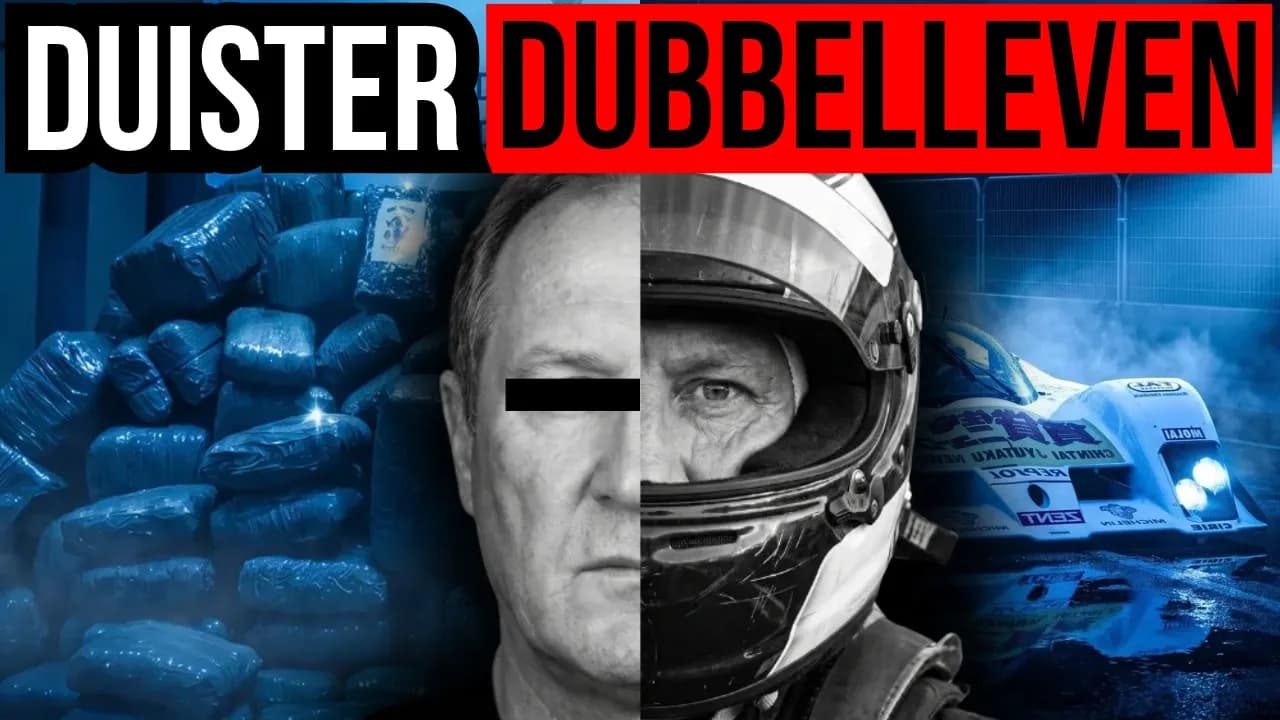
Charles Zwolsman combined a career in Dutch and international motor racing with a large-scale hashish-smuggling operation. Born in Oostzaan in 1955, he started out racing karts and later supported his young family through a flower business. As racing costs rose and the business faltered, he turned to hashish trafficking. After an early seizure of 2,000 kilos resulted in no conviction, he expanded his operation, though he was sentenced to two years in prison in 1987. After his release, Zwolsman built a network of about 60 people using refrigerated trucks to move hashish from Morocco and Spain through the Netherlands and onward to markets including the United Kingdom and Sweden. Prosecutors later cited at least 44 tons between 1989 and 1993, and alleged a much higher total across the full period. The proceeds helped fund his return to racing, including his own team, Euro Racing. He competed at the 24 Hours of Le Mans three times, finishing 13th in 1992 after switching to a teammate’s car. Police had been investigating Zwolsman’s group while he raced, and a multidisciplinary team named Formula gathered evidence. A speeding stop in June 1992 led to his arrest, after which he faced charges involving hashish imports and participation in a criminal organization. He was sentenced to four years in 1994, and his appeal increased the sentence to five years. The case also became part of the IRT affair, as investigators’ use of methods including allowing drug shipments to continue was scrutinized. A parliamentary inquiry concluded that authorities had exceeded their powers, while Zwolsman’s conviction remained in place. After his release, authorities pursued the recovery of criminal proceeds under the Plukze law, with the amount changing through years of legal challenges. In 2006, police arrested Zwolsman in a case involving hashish and firearms found at a farm in Zwartebroek; he received a three-year sentence in 2010. A later investigation, codenamed Doomer, examined a wider alleged network and suspected that money had flowed through accounts and racing-related investments, including a team connected to his son. Zwolsman died in his cell in Nieuwegein on January 21, 2011, aged 55, while the Doomer case continued without him. The account presents his life as an unusual entanglement of racing ambition, drug trafficking, prosecution, and disputes over investigative methods.
- 06 · Los Ecomonos
The video examines the financial risks behind OpenAI’s expansion, using a banana-shop analogy to explain how the companies financing AI infrastructure depend on one another. It cites Financial Times forecasts that OpenAI could bring in about $840 billion between 2026 and 2030 while spending $856 billion on computing power and infrastructure alone. The video stresses that these are projections, not losses already recorded, and says the resulting funding gap could reach $278 billion by 2030. OpenAI rents computing capacity from CoreWeave, which borrows money to buy Nvidia chips and build data centers. Nvidia has invested $2 billion in CoreWeave and agreed to pay up to $6.3 billion if CoreWeave cannot find enough customers for its servers. The video describes these connected investments, loans, and commercial commitments as circular financing that could spread financial trouble between the companies.
- 07 · Invertir para Conseguir
The host, Carlos Barrera Pasán, interviews Jorge Soriano, CEO and founder of Criptan, about Bitcoin’s decline and how investors might approach the market. Soriano says Bitcoin has changed from an asset driven largely by fast speculation, while regulation, macroeconomic conditions, liquidity, and institutional participation now shape its price. He notes that the host describes a 30% fall over the previous year and says people should not expect predictable short-term gains. Soriano also points to the growth of spot Bitcoin ETFs in the United States as a change in how institutions can access the asset. Rather than making a categorical buy-or-sell call, he argues that investors should assess Bitcoin as one possible part of a diversified portfolio. He emphasizes that no one can reliably predict when Bitcoin will rise or how high it might go.
- 08 · WTFinance
Trobi says he invested around €150,000 in a nightclub in Greece, after his business partner Antonis proposed opening an international club in anticipation of increased tourism. The idea began when Antonis told him the island was getting a larger international airport. Trobi says he saw an opportunity in the short but lucrative summer season and thought his social media experience could help promote the club. He describes his contribution as a creative one, while the local team handles daily operations. Trobi says the club was built in about two months and opened despite not being fully ready. After the first nights, he identified practical changes to consider, including adding another bar.
- 09 · Matthieu Louvet - S'investir
Le présentateur compare des PER selon cinq catégories et plus de 40 critères, notamment les frais, les fonds en euros, les supports d’investissement, les modes de gestion et le service client. Il rappelle que les versements peuvent être déduits du revenu imposable dans la limite d’un plafond, mais que les sommes retirées sont imposées. Il estime que le PER est généralement plus adapté aux contribuables dont la tranche marginale d’imposition atteint au moins 30 %. L’épargne est en principe bloquée jusqu’à la retraite, avec des exceptions comme l’achat de la résidence principale. Il précise aussi qu’un transfert vers un autre PER peut coûter jusqu’à 1 % avant cinq ans de détention, puis devient gratuit. Les frais annuels peuvent fortement peser sur une épargne conservée pendant plusieurs décennies. Pour illustrer l’écart, le présentateur compare un placement de 50 000 euros sur 25 ans avec un rendement brut annuel de 5 % : il estime le capital final à environ 157 600 euros avec 0,3 % de frais et à 136 500 euros avec 0,9 % de frais. Il distingue les frais justifiés par un accompagnement de ceux qui n’apportent pas de service supplémentaire. Il attire aussi l’attention sur les frais de versement, d’arbitrage et de sortie en rente. Parmi les contrats comparés, il relève les frais particulièrement faibles de Lucya CNP et les frais élevés du PER BNP Paribas. Pour le fonds en euros, la comparaison porte sur les performances passées, le niveau de garantie et les conditions d’accès. Le présentateur cite Garance Vivacité comme le fonds en euros le mieux classé, avec un rendement annoncé de 4,5 % en 2025 et 19,09 % cumulés sur cinq ans, sans condition d’investissement en unités de compte. Il explique également que certains fonds ne garantissent pas la totalité du capital, comme celui de Linxea Spirit, garanti à 98 %. Pour les unités de compte, il recommande de vérifier les ETF réellement disponibles, les frais, les SCPI, la part des loyers reversée et les autres classes d’actifs. Il souligne que le nombre brut de supports ne suffit pas à juger la qualité d’un PER. Dans le classement présenté, Linxea Spirit obtient la première place avec 4,85 sur 5, grâce notamment à son large choix de supports, ses frais de versement nuls et ses 209 ETF. Lucya CNP et Meilleur Taux Liberté obtiennent chacun 4,75 sur 5, tandis que Matla, Garance Vivacité, Corum PER Life et d’autres contrats répondent à des profils différents. Le présentateur privilégie Linxea Spirit comme PER principal en gestion libre, Lucya CNP pour réduire les frais d’un investissement orienté ETF et Garance Vivacité pour rechercher un fonds en euros performant. Il recommande d’examiner les conditions de chaque contrat et de choisir selon son horizon, sa tolérance au risque et ses objectifs de sortie. Il rappelle enfin que les classements et les conditions évoluent, et invite à vérifier le comparateur régulièrement mis à jour.
- 10 · Doopie Cash
In Beurstafel #51 bespreken de presentatoren de brede beursdaling en aandelen die onder druk staan, waaronder NVIDIA, AMD, Alibaba en ASML. Ze noemen dat de S&P 500 bijna 12% is gedaald en dat de rode cijfers beleggers aan het twijfelen kunnen brengen. De vraag van de week is wat beleggers moeten controleren voordat ze bijkopen of verkopen na een koersdaling en een kritisch rapport. De panelleden adviseren terug te gaan naar het eigen beleggingsplan, de waardering en de analyse, en het nieuws niet zonder onderzoek terzijde te schuiven. Ze halen AMD aan als voorbeeld van een aandeel dat ongeveer 8% daalde na een kritisch bericht van Hunterbrook, dat volgens de bespreking ook een shortpositie had.
- 11 · LMGClips
Linus predicts that shoppers planning to buy a GPU on Black Friday should wait, saying a better deal may appear in the new year. He cautions that retail prices could take time to respond because GPU production requires wafer allocation, memory manufacturing, board production and shipping. He expects the used market to react sooner, as sellers may try to move expensive GPUs and DDR5 ECC memory before prices fall. Linus and Luke also note that eager buyers could jump in as soon as prices dip, limiting the decline or causing temporary price spikes. Their outlook is uncertain because production and supply adjustments happen with a delay. The central advice is to avoid assuming Black Friday is the best time to buy a GPU.
- 12 · Invertir para Conseguir
The video outlines five financial steps to take before the end of the year: calculate net worth, review spending, assess pension plans, use investment losses to offset gains, and automate saving and investing. To calculate net worth, list assets such as cash, investments, a home, and a car, then subtract debts such as a mortgage, loans, and credit-card balances. One example gives €259,000 in assets and €158,000 in liabilities, resulting in net worth of €101,000. The presenter also recommends reviewing wealth over time, checking how much cash is idle, and keeping about six months of expenses in an emergency fund before investing money intended for longer-term goals. For budgeting, the video uses the 50/30/20 rule: on a €2,000 monthly net income, that would mean €1,000 for needs, €600 for leisure, and €400 for saving and investing.