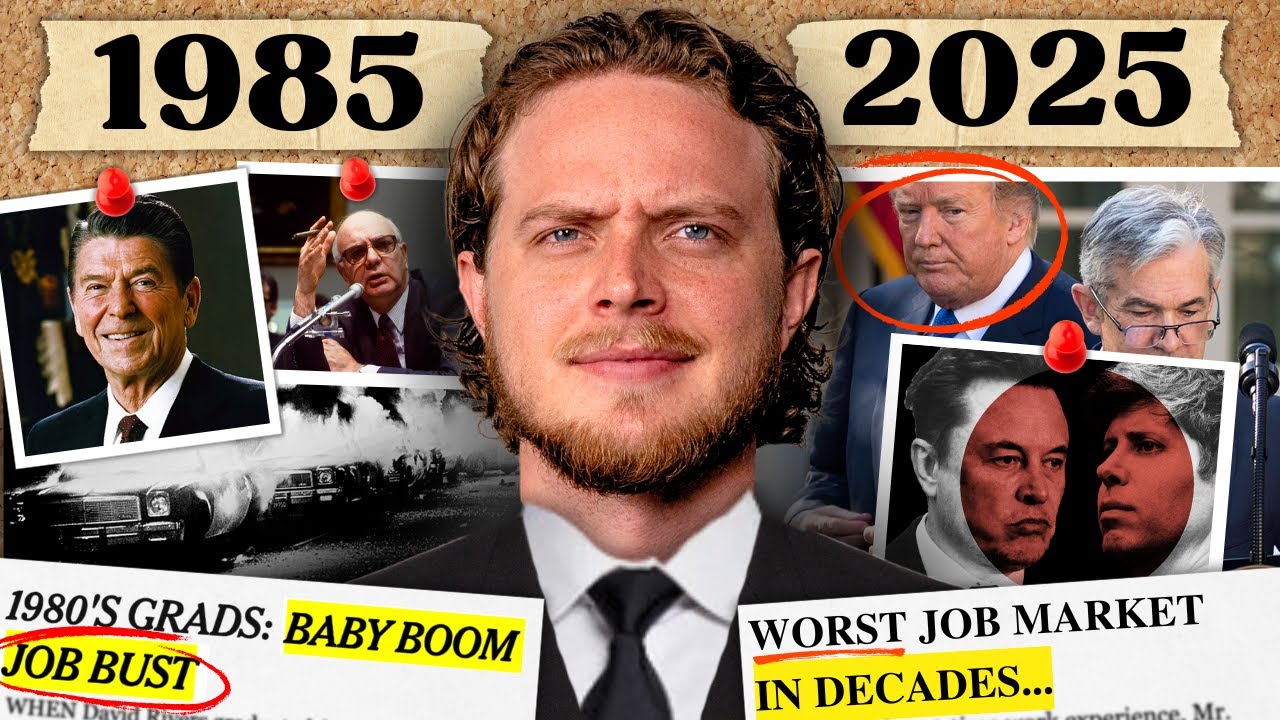
Baby Boomers DID NOT Have It Worse
Cette vidéo existe aussi avec une piste audio en français (doublage automatique). Dans le lecteur, ouvrez Paramètres → Piste audio et choisissez français.
Votre note
Réactions
AudioAnglais (original)Doublage automatique: Français, Allemand, Espagnol, Hindi, Indonésien, Italien, Japonais, Malayalam, Polonais, Portugais+1 autres
Chaînes et réseaux sociaux
Baby Boomers, Gen Z, Gen X, and Millennials have all faced a changing job market shaped by inflation, unemployment, wealth inequality, mass layoffs, and the ongoing cost of living crisis. From the 1980s to 2025, the American workforce has transformed dramatically, creating a widening gap between generations struggling to build stable careers, afford homes, and achieve financial security. As inflation continues to erode wages and the housing crisis pushes ownership further out of reach, questions around opportunity, job stability, and the true value of hard work have never been more relevant. The 1980s marked a turning point in the modern economy, with Baby Boomers entering peak earning years as Gen X prepared to inherit a rapidly changing job market. Factories closed, outsourcing increased, and wage growth stagnated while costs of living rose across the nation. Yet, for many Boomers, affordable housing and job security were still within reach, setting the foundation for decades of perceived prosperity. Fast forward to today, and younger generations—Millennials and Gen Z—are navigating an economy defined by automation, mass layoffs, student debt, and skyrocketing rent prices that have fundamentally reshaped what success looks like in America. The generational divide has become one of the most defining features of the 21st century. Millennials and Gen Z are entering a job market where long-term careers are replaced by temporary contracts, remote work competition, and algorithm-driven hiring systems. Meanwhile, Baby Boomers and Gen X continue to hold a majority of the nation’s wealth, leaving younger workers questioning whether the system still rewards effort or simply preserves power for those who came before. This growing economic tension highlights how inflation, globalization, and automation have deepened wealth inequality and forced younger generations to work harder for less in an unstable economy. As the housing crisis accelerates and wages struggle to keep pace with rising costs, the dream of financial independence feels further away than ever. Millennials, who came of age during the Great Recession, and Gen Z, who entered the workforce during a global pandemic, face the dual challenge of navigating a career landscape that no longer guarantees stability while managing debt and rent levels unseen in previous generations. By contrast, Baby Boomers built their careers during a time of economic expansion and accessible homeownership, creating a generational wealth gap that continues to shape American life today. Across every generation, one truth remains clear—the American Dream has become increasingly difficult to achieve. Whether measured through homeownership, savings, or job security, the promise of upward mobility has been replaced by uncertainty. The generational debate over who had it better—those who entered the workforce in the 1980s or those coming of age in the 2020s—reveals deeper systemic failures that transcend time. Inflation, stagnant wages, and a shrinking middle class have turned what was once a ladder of opportunity into a cycle of economic survival, forcing Americans of every age to confront what “success” truly means in the modern economy. #financialeducation #financialfreedom #history Freddies Channel: @Fmsmith319 Support The Channel: patreon.com 0:00 Intro 0:51 Why Baby Boomers Are Convinced It’s The Avocado Toast 1:53 Why The Cost Of Living Has Skyrocketed Since The 1980’s 3:30 Why Baby Boomers Perceived The 1980’s To Be More Difficult 5:26 How Wealth Inequality Has Destroyed America Since The 1980’s 9:44 Why Gen Z Is Not Having Children 10:46 Why The Working Class Does Not Benefit From This “Great” Economy 13:35 Why Gen X Experienced A LIFETIME Of Poor Economic Conditions 15:04 On Average Gen X Is Making LESS Than In 2000 (Factual Proof) 17:00 Why Everyone Forgets About Gen X 18:39 Why The FAILING Dollar Is Destroying Gen Z 19:42 Why The Elite Want To Keep Us Divided 21:23 Do Generational Discussions Matter? Titles for the Algo! 1985 vs 2025, Who Actually Had It Better? 1985 Vs 2025, Who Actually Had It Better? 1985 vs 2025, Who REALLY Had It Better? 1985 Vs 2025, Who REALLY Had It Worse? 1985 vs 2025, Who Really Had It WORSE?
Aperçu IA
The video compares economic pressures facing Baby Boomers, Gen X, Millennials, and Gen Z, arguing that generational hardship should be understood through the cost of living and wages rather than stereotypes about spending. Guest Freddy Smith contrasts the high 1980s prices of consumer electronics with lower housing and other necessity costs, while the hosts discuss how a typical home down payment has become much harder to save for. They also describe changes since the 1980s, including outsourcing, weaker labor unions, stagnant wages, and a shift toward service-sector jobs. The conversation cites an increase in total U.S. wealth from about $40 trillion around 1980 to $170 trillion in 2025, while claiming that only $2 trillion of the increase went to the bottom half of Americans. The speakers argue that wealth concentration and corporate priorities have made it harder for many workers to afford housing, save, and build financial security. They conclude that comparing generations is less useful than recognizing shared economic pressures and working across age groups to address inequality.
Sujets · economy · gen z · job market · housing crisis · wealth inequality in america · education
Questions traitées
- Why do the speakers say Gen Z has a harder time buying a home than Baby Boomers did?
- They contrast 1980s home prices and relatively lower costs for necessities with today's higher housing costs, rents, and down payment requirements, which make homeownership harder to reach for younger adults.
- How does the video describe the change in U.S. wealth since around 1980?
- The speakers cite total U.S. wealth rising from about $40 trillion around 1980 to $170 trillion in 2025, and say only $2 trillion of that increase reached the bottom 50%.
- Why does Freddy Smith say Gen X has faced difficult economic conditions?
- He describes Gen X as having encountered the dot-com bubble, the September 11 attacks and ensuing wars, the recession, a pandemic during peak earning years, and responsibility for both children and aging parents.
- What wage comparison does the discussion make about Gen X?
- It gives an example of a roughly $35,296 salary in 2000, equivalent to about $68,000 today, and estimates that 2.5% annual wage increases would produce about $65,300 today, less in purchasing power than the inflation-adjusted 2000 salary.
- What does the video recommend instead of arguing over which generation had it worse?
- The speakers call for conversations across generations and cooperation to address wealth inequality and corporate influence, rather than blaming one another for economic problems.


