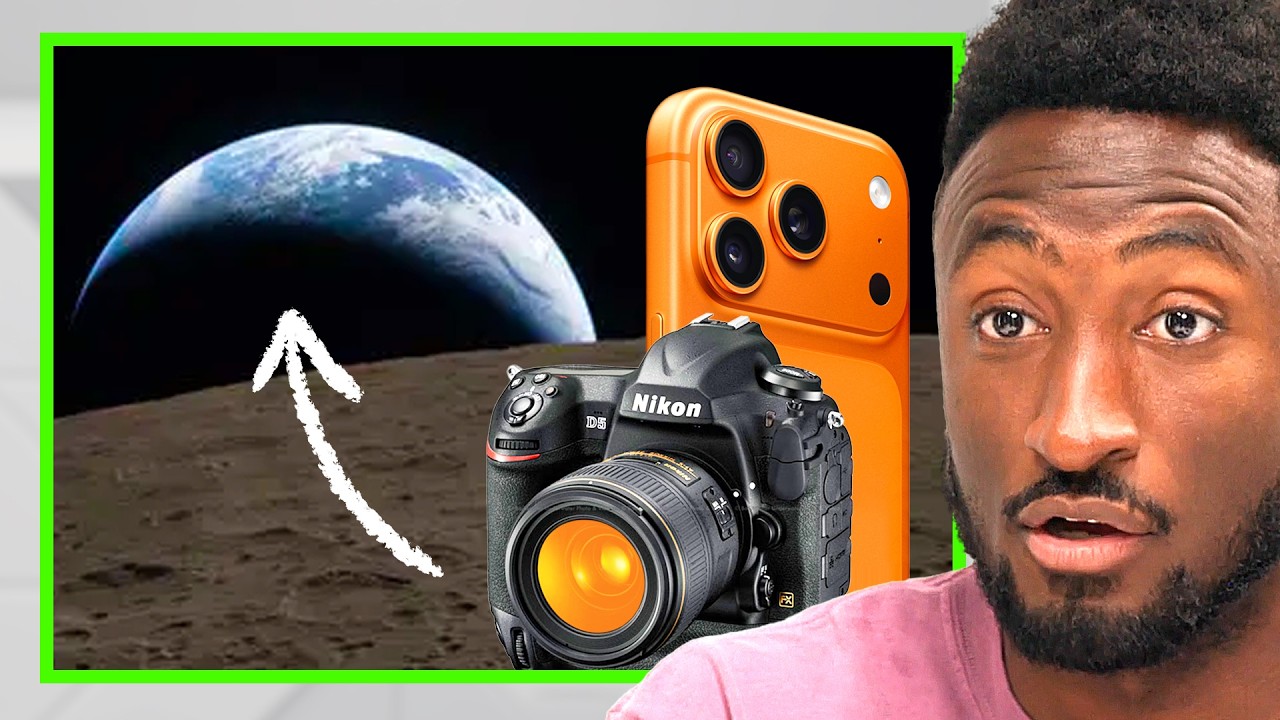
The Cameras NASA Brought to the Moon
Tu valoración
Reacciones
Canales y redes sociales
In this clip, Marques, Andrew, and David discuss the cameras that captured some of the moon pictures from the Artemis II mission. Watch full episode: youtu.be Follow us on socials: Waveform Threads: @waveformpodcast Waveform Instagram: @waveformpodcast Waveform TikTok: @waveformpodcast Marques: @mkbhd Andrew: @andrew_manganelli David: @davidimel Adam: @parmesanpapi17 Ellis: twitter.com Join the Discord: discord.gg Intro/Outro music by 20syl: bit.ly Waveform is part of the Vox Media Podcast Network.
Resumen de IA
The discussion focuses on photographs taken during the Artemis II crewed trip around the Moon, including images captured on astronauts’ personal phones. The hosts describe the mission’s path around the far side of the Moon and the unusual perspective of seeing Earth and the Moon together. They explain that the Nikon D5 was selected in part for its large pixels, which collect more light per pixel and can reduce noise against a mostly black background. The Nikon Z9 is also discussed, with its higher 45.7-megapixel resolution and smaller pixels. The group mentions a GoPro Hero 4 Black and considers why a space mission might use camera models that are no longer the newest. They suggest that equipment is selected and validated early in long-running programs, when reliability matters more than having the latest features.
Temas · science & technology · space exploration · photography · cameras · astronomy
Preguntas respondidas
- Why was the Nikon D5 used for Artemis II space photography?
- Its large pixel pitch lets each sensor pixel gather more light, which can help reduce image noise against the dark background of space.
- Which camera models are discussed as being used on the Artemis II mission?
- The discussion names the Nikon D5, Nikon Z9, and GoPro Hero 4 Black, as well as astronauts’ personal smartphones.
- Why might a space mission use cameras that are not the newest models?
- The speakers explain that equipment for long-running programs is selected and validated years in advance, and newer equipment may not have been tested and approved for the mission.
- How were images and live video transmitted from the spacecraft to Earth?
- The speakers describe data being sent back through a network of satellites, with at least one satellite able to maintain a connection to the spacecraft.
- What made the solar eclipse seen by the Artemis II crew unusual?
- The crew saw the Sun behind the Moon from their position during the lunar flyby, a perspective the speakers describe as unprecedented for human observers.