The Historical Oddities Iceberg Explained
Tu valoración
Reacciones
Canales y redes sociales
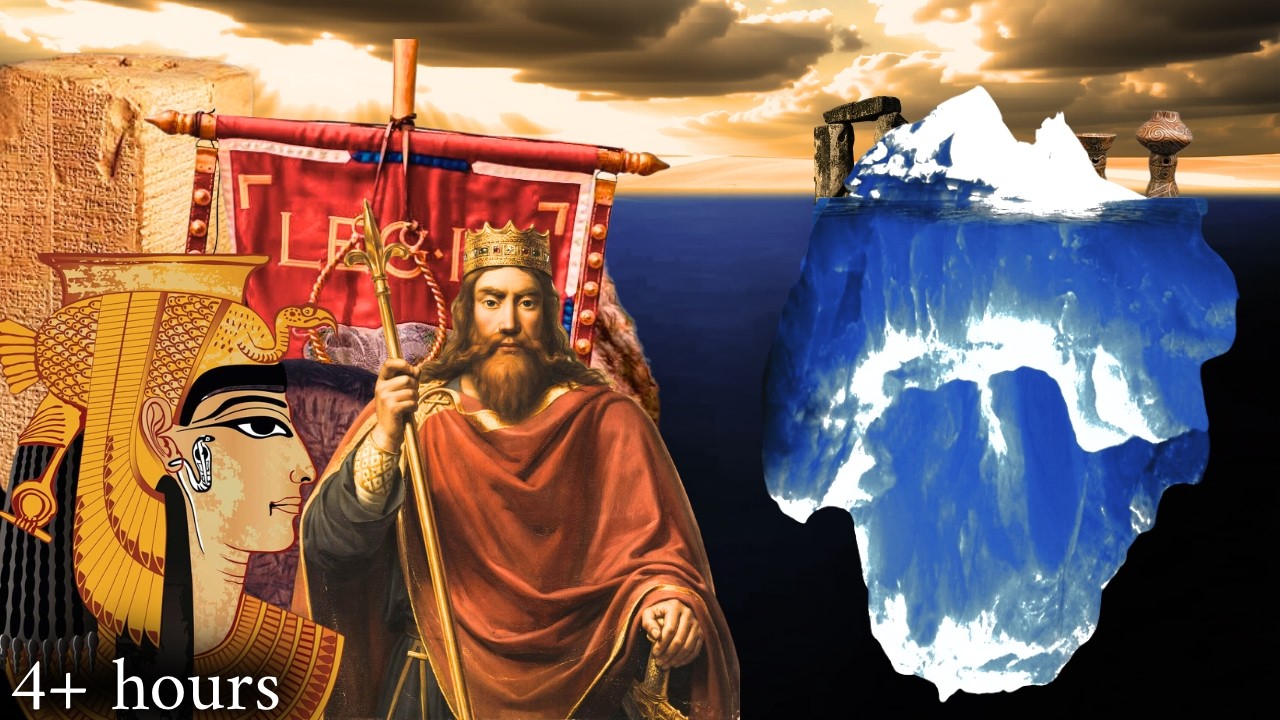
Welcome everyone to the Historical Oddities Iceberg, which will cover many interesting and obscure historical oddities . I hope you all enjoy, and thank you for watching! Copyright disclaimer under section 107 of the copyright act 1976, allowance is made for fair use for purposes such as criticism, comment, news reporting, teaching, scholarship, and more. no copyright infringement intended. Background video: youtube.com - DayDream Gaming
Resumen de IA
This nearly five-hour iceberg covers nearly 250 historical oddities, ranging from familiar archaeological questions to fringe claims. Its entries include the Great Sphinx of Giza, Stonehenge's Altar Stone, and the question of whether Socrates went into space. The narration often distinguishes evidence from speculation, explaining what researchers know and what remains uncertain. It also revisits popular stories whose details have been exaggerated or misattributed. The result is a survey of unusual history organized by increasingly obscure subjects. Several entries examine ancient sites and artifacts with unresolved purposes or origins. The transcript discusses the Hanging Gardens of Babylon, including Stephanie Dalley's proposal that they may have been built at Nineveh instead. It describes the Roman dodecahedrons, for which more than 50 possible uses have been proposed without a settled answer. Other examples include Rongorongo, an undeciphered script from Rapa Nui, and the Indus Valley script, whose short surviving inscriptions complicate attempts to read it. These cases show how limited evidence can leave even well-known archaeological finds open to competing interpretations. The video also tests famous historical legends against surviving records and research. The claim that Caligula made his horse a senator is presented as a myth, although the horse Incitatus reportedly lived in extraordinary luxury. The story of Columbus discovering America is complicated by Indigenous peoples already living there and by Leif Ericson's earlier voyage to North America. The account of Tulip Mania is described as exaggerated, with historian Anne Goldgar finding relatively few people who paid very high prices for bulbs. These examples emphasize the gap between memorable retellings and the evidence described in the transcript. Other entries focus on ancient societies, their achievements, and possible reasons for decline. The Maya collapse is presented as a cascade involving drought, conflict, migration, and economic disruption rather than a single cause. The transcript similarly describes the Hittite Empire's end as a combination of drought, famine, raids, and desertion. It explains that the Ancestral Puebloans did not simply vanish, but that their descendants became modern Pueblo peoples. The examples frame historical change as complex, with environmental and social factors interacting. The iceberg also includes unusual events and disputed claims from more recent history. The 1908 Tunguska explosion flattened an enormous area of forest without leaving a confirmed impact crater, and the leading explanation described is an object exploding in the atmosphere. The 1932 Australian emu operation is recounted as a military failure that was mocked in the press. The Cardiff Giant is identified as a hoax organized by George Hull, while the Coso object is identified as a 1920s-era spark plug rather than ancient technology. Across these stories, the narration contrasts sensational interpretations with explanations supported by the evidence it describes. In its deeper entries, the video ranges from folklore and religious traditions to alleged out-of-place artifacts. It explains that the helicopter-like Abydos carvings are understood by Egyptologists as overlapping inscriptions, not ancient aircraft. The Baygong pipes are described as formations most researchers consider fossilized tree roots, despite claims about extraterrestrial builders. Scottish Blue Men of the Minch and Icelandic Huldufólk are presented as folklore tied to local landscapes and beliefs. The closing sample turns to a possible stone arrangement beneath Lake Michigan, where researchers have not reached a consensus about whether a marked boulder is human-made or natural.
Temas · history · archaeology · mystery · folklore · iceberg explained · unexplained
Preguntas respondidas
- How many topics does The Historical Oddities Iceberg cover?
- The introduction describes nearly 250 entries in an iceberg video designed to run for about five hours.
- Were the Hanging Gardens of Babylon definitely located in Babylon?
- Their location is disputed. Stephanie Dalley proposed that they were built at Nineveh, based partly on Assyrian reliefs and evidence of an aqueduct system there.
- What is the best-supported explanation for the helicopter hieroglyphs at Abydos?
- Egyptologists explain them as a palimpsest created when Ramesses II carved his titles over inscriptions made for Seti I, with later erosion making the shapes look like modern machines.
- Did Caligula appoint his horse Incitatus to the Roman Senate?
- No. The transcript calls that claim a myth, although ancient writers describe Incitatus as living in extraordinary luxury.
- What caused the Maya civilization's collapse?
- The transcript describes a cascading failure involving drought, wars, migration, and economic disruption across connected communities, rather than one cause affecting every region.
- What is the likely explanation for the Tunguska explosion?
- Most researchers favor an asteroid or comet fragment that exploded in the atmosphere, flattening forest without leaving an impact crater.
- Was the Coso artifact an ancient spark plug?
- No. Researchers identified it as a 1920s-era Champion spark plug enclosed in a relatively young mineral concretion.
- Have the Roman dodecahedrons' purpose and use been established?
- No. More than 50 theories have been proposed, but none fully fits the evidence, and their purpose remains unresolved.